
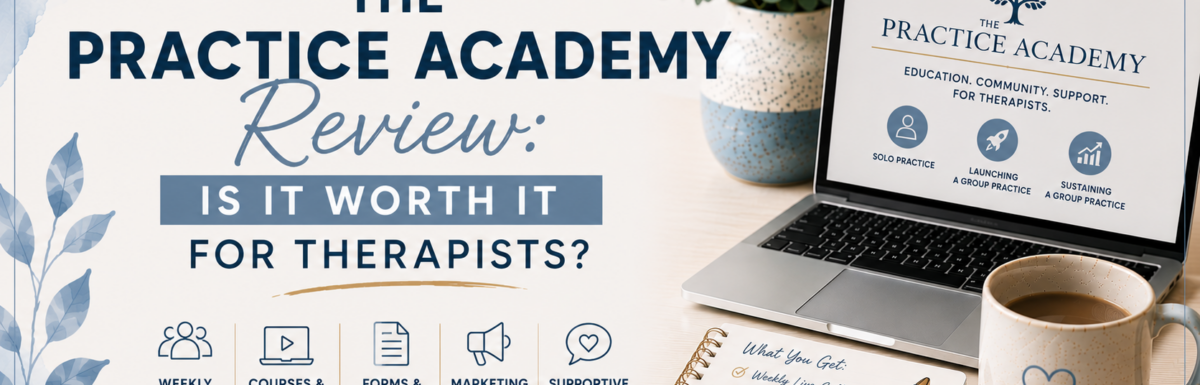
Affiliate disclosure: This post contains affiliate links. If you sign up through one of these links, we may earn a commission at no extra cost to you. All opinions are based on independent research into the program.
Quick verdict
The Practice Academy is a private practice business membership from Joe Sanok’s Practice of the Practice. It’s worth it for therapists who are starting, growing, or moving to a group practice, and who will actually show up to the live calls and community. It’s harder to justify at $195/month if you only want templates, prefer fully self-paced learning, or already have solid systems in place.
Best for: newer solo owners, side-practice owners, and therapists planning their first hire
Skip it if: you want one inexpensive course or won’t use the live support
Check current pricing and tracks
At a glance
| Made by | Practice of the Practice (Joe Sanok) |
| Cost | $195/month or $1,950/year (advertised as “Two Months Free”) [confirm] |
| Format | Online membership: 30+ courses, live calls, community [confirm “online”] |
| Live support | 1 weekly call (Track 1); 2 weekly calls (Tracks 2 & 3); plus Q&A and office hours |
| Resources | Forms, templates, financial calculators, marketing and referral resources |
| Best for | Building or growing a practice with accountability |
| Not ideal for | Experienced owners with systems in place; self-paced-only learners |
If you’ve ever thought about starting a private practice and then immediately felt overwhelmed by everything you don’t know, you’re not alone.
Graduate school teaches therapists how to be therapists. It doesn’t necessarily teach you how to set your fees, choose an EHR, market yourself, create policies, build referral relationships, manage a website, or eventually hire other clinicians.
That’s where The Practice Academy comes in.
The Practice Academy is part of the broader Practice of the Practice brand founded by Joe Sanok. His work has focused on the business side of private practice since he launched Practice of the Practice in 2012. The brand now includes a podcast, blog, education, consulting, communities, and other resources for private practice owners.
So, is The Practice Academy worth the investment?
For the right therapist, I think it can be. But at $195 per month, I wouldn’t recommend joining simply because it has more than 30 courses.
The real value is the combination of education, live support, community, practical resources, and accountability. If you’re willing to participate and actually implement what you learn, there’s a much stronger case for the cost.
If you’re mainly looking for a handful of templates or a self-paced course you can finish in a weekend, I’d probably spend the money elsewhere.
Here’s what you should know before joining.
What Is The Practice Academy?
The Practice Academy is a membership-based education and support community for therapists and private practice owners.
Rather than putting everyone through exactly the same curriculum, the Academy organizes its membership around different stages of practice development:
- Sustainable Solo Practice — for therapists starting, growing, or building a solo practice
- Group Practice Launch — for therapists preparing to build and manage a group practice
- Sustainable Group Practice — for established group practice owners who want to improve leadership, operations, delegation, and growth
That structure makes sense. The problems a therapist faces when trying to get their first private practice off the ground aren’t necessarily the same problems that show up when you have several clinicians working for you.
The current membership includes more than 30 courses, live calls, community access, Q&A and office hours, financial tools, client-management resources, forms and templates, marketing resources, and practice-management materials. Members can also move into the next track as their practice develops without paying an additional membership fee.
Who Is Joe Sanok?
Joe Sanok’s background is worth considering when evaluating The Practice Academy.
There is certainly no shortage of people selling courses about how therapists can build a six-figure practice. Joe Sanok, however, has been working in this space for more than a decade.
Sanok launched Practice of the Practice in 2012 to blog about what he was learning about business, marketing, and private practice. He has described starting the site after realizing how little he knew about the business side of practice when he finished graduate school.
Over the years, Practice of the Practice has expanded into podcasting, education, consulting, communities, webinars, and other resources for private practice owners. The podcast also dates back to the early days of the business, with the first episode published in 2012.
That background doesn’t automatically make The Practice Academy worth $195 a month. But it does give the program some credibility that a brand-new therapist-business course doesn’t necessarily have.
Much of Sanok’s work has focused specifically on the business side of counseling and private practice, rather than being generic small-business coaching with a therapist module added later.

What Do You Get With The Practice Academy?
1. More Than 30 Courses
The Academy currently includes more than 30 courses covering different aspects of building and managing a private practice.
Topics include areas such as:
- Practice foundations
- Marketing
- Client retention
- Financial management
- Practice operations
- Referral development
- Website and Psychology Today marketing
- Team development
- Leadership
- Systems and delegation
For a newer therapist, this could be one of the more useful parts of the membership.
Instead of searching Google every time you run into a new business question, you have a structured place to start.
And that’s important because the hardest part of starting a business isn’t always finding information. Sometimes it’s figuring out what to do next.
2. Live Calls and Coaching
This is one of the biggest differences between The Practice Academy and simply buying an online course.
Members have access to live calls with faculty and other community members, with the number of weekly calls depending on the track. The current site lists one weekly live call for Track 1 and two weekly live calls for Tracks 2 and 3. Q&A and office-hour support are also included.
That can be useful when you’re stuck on something specific.
Maybe you’ve gone through the marketing material but still don’t know what to put on your website.
Maybe you’ve raised your fees and are second-guessing yourself.
Maybe you’re ready to bring on your first clinician and aren’t sure what needs to happen next.
Being able to ask questions and talk through those situations can be much more useful than watching another hour of prerecorded videos.
3. Community
Community is a major part of the Academy, and it’s important to understand that before joining.
This isn’t really designed to be a membership where you download a bunch of templates and disappear.
The program emphasizes connecting with other therapists and practice owners, participating in live conversations, asking questions, and getting support as you work through the different stages of building a practice. The current membership materials describe the community as an active network of therapists and practice owners.
For some therapists, this may end up being the most valuable part of the membership.
Running a private practice can be surprisingly isolating. You can have plenty of professional colleagues without having anyone who understands what it’s like to worry about your caseload, marketing, revenue, hiring, delegation, or whether you’re charging enough.
Being around other people who are dealing with similar business decisions is different from simply searching for answers online.
But there’s an important catch: you have to participate to get that benefit.
If you’re someone who doesn’t enjoy communities, live calls, or asking questions, you may not get as much value from this particular membership.
4. Forms, Templates, and Practical Tools
The Academy isn’t limited to business strategy and mindset.
Depending on the track, members have access to practical resources such as financial calculators, rate-raise templates, payment logs, cancellation-policy scripts, email automations, intake forms, release forms, practice paperwork, marketing resources, referral scripts, and contractor or team-related resources.
For someone starting from scratch, having a starting point can be much less intimidating than creating every document and process from nothing.
That said, I’d look at these resources as starting points, not as a substitute for professional legal or clinical guidance when you need it.
Ready to See If The Practice Academy Is Right for You?
If you’re tired of piecing together private practice advice from podcasts, Facebook groups, and random Google searches, The Practice Academy gives you a more structured place to learn, ask questions, and actually put the information into practice.
Want to see what’s included? Check out The Practice Academy and take a look at the current membership options, courses, and support available.
The Three Practice Academy Tracks
One of the things I like about the Academy is that it recognizes that building a private practice isn’t one single stage of business ownership.
Track 1: Sustainable Solo Practice
This track is designed for therapists who are starting a practice, building a side practice, or working toward a sustainable solo practice.
The emphasis is on building a practice that supports your life rather than simply filling your calendar.
The track includes the courses, community, weekly live support, financial tools, client-management resources, practice-foundation materials, and foundational marketing training.
For a therapist with strong clinical skills but limited business experience, this is probably the most logical place to start.
Track 2: Group Practice Launch
Ready to hire?
Track 2 focuses on moving from solo practice into group practice. The current curriculum is structured as a month-by-month roadmap covering areas such as foundation and legal structure, team integration, operations, branding and marketing, leadership, and future planning.
That structure could be particularly useful when you’re hiring your first clinician because bringing another person into the business introduces an entirely different set of challenges.
You aren’t just managing your own schedule anymore. You have to think about systems, communication, delegation, team culture, financial decisions, and how work gets done.
Track 3: Sustainable Group Practice
Already have a group practice?
Track 3 focuses more heavily on leadership, team management, delegation, and operational efficiency. Current resources include leadership templates, performance-review tools, onboarding resources, and delegation SOPs for areas such as billing, administration, and marketing.
That’s a very different problem than getting your first few clients, which is exactly why having separate tracks makes sense.
Which Track Should You Choose?
Choose Sustainable Solo Practice if you’re launching your practice, growing a side practice, or still filling your caseload. This track gives you the structure most new owners are missing: marketing, finances, and client retention in a set order.
Choose Group Practice Launch if your caseload is full and you’re thinking about hiring your first clinician. Before you join, it helps to know what you’d hand off. Our guide to running a therapy private practice walks through the software and systems to have in place first.
Choose Sustainable Group Practice if you already have a team and your bottleneck is leadership, delegation, and operations rather than getting clients.
What I Like About The Practice Academy
It focuses on the business side of therapy
This is probably the biggest selling point.
You can be an excellent therapist and still have no idea how to set your fees, create business policies, market your practice, build referral relationships, or manage a team.
The Academy is specifically designed around those business questions.
There’s an emphasis on actually doing the work
Information isn’t particularly useful if you never implement it.
The live calls and community add an accountability component that a self-paced course doesn’t provide on its own.
That doesn’t mean you’ll automatically grow your practice because you joined. You still have to do the work.
But having a place to ask questions, get unstuck, and talk through your next step can make implementation easier.
The material is specific to private practice
This is another advantage.
The Academy isn’t simply general entrepreneurship training that happens to mention therapists.
Practice of the Practice has been built around private practice and counseling, so the examples and topics are much closer to the situations therapists actually encounter.
Where The Practice Academy Falls Short
You have to participate
This is both a strength and a potential downside.
If your plan is to join, download a stack of templates, watch two videos, and never attend a call or interact with anyone, I don’t think you’re likely to get your money’s worth.
The Academy is designed around education plus live support, community, and implementation.
If you want a completely self-paced experience, there are less expensive options.
It isn’t cheap
The current price is $195 per month or $1,950 per year. The annual option is advertised as two months free compared with paying monthly for a full year.
That’s a meaningful investment for a therapist who is just getting started.
And the value you’ll get from the membership depends heavily on how much you actually use it.
If you’re attending calls, working through the courses, asking questions, using the resources, and implementing what you’re learning, the price becomes easier to justify.
If you log in once every few weeks, it becomes much harder to justify.
There is a lot of information
Ironically, having more than 30 courses can create its own problem: where do you start?
If you’ve ever joined an online program and immediately thought, “Where am I even supposed to begin?” you know what I mean.
The good news is that the track structure gives you a way to narrow your focus.
I wouldn’t recommend trying to consume everything.
Use the Academy to solve the problem that’s in front of you right now.
You don’t need to finish 30 courses. You need to figure out what needs fixing or building next.
It may be more than you need
This is an important consideration.
If you’ve already been running a solo practice for years, have your systems in place, understand your marketing, and feel confident about the business side, you may find yourself paying for a lot of foundational information you don’t need.
The Academy makes more sense for someone who still has significant gaps in their business knowledge or wants ongoing support as the practice grows.
What Do Other People Say?
The testimonials published by Practice of the Practice are generally positive and highlight the resources, guidance, webinars, and community.
For example, testimonials on the company’s site describe members feeling less lost and benefiting from the guidance and resources provided through the membership.
But there’s an important distinction here.
These are company-published testimonials, not independent reviews.
I wouldn’t treat them as equivalent to reviews from people who have no connection to the program.
If you’re considering joining, it’s worth looking beyond the testimonials published on the Academy’s own website.
Reviews are also available on the Practice of the Practice Facebook page, which gives you another place to look for member perspectives.
Read Practice of the Practice reviews on Facebook
I’d recommend reading those before making a decision, particularly if you’re on the fence about spending $195 per month.
Who Should Join The Practice Academy?
I think The Practice Academy makes the most sense for therapists who:
- Are starting a private practice
- Have a side practice they want to grow
- Feel overwhelmed by the business side of practice ownership
- Want a roadmap rather than random information
- Want accountability
- Like learning alongside other therapists
- Are considering moving from solo to group practice
- Already own a group practice and want better systems
- Want access to live coaching and support
- Are willing to participate in the community
Who Probably Shouldn’t Join?
I’d look elsewhere if you:
- Prefer completely self-paced learning
- Don’t want to participate in a community
- Already have strong business and marketing systems
- Are primarily looking for a few templates
- Want a single inexpensive course
- Aren’t willing to implement what you learn
- Already have extensive experience running a private practice and don’t need much foundational material
That doesn’t mean The Academy is bad for these therapists.
It just means $195 a month may not be the best use of their money.
Is The Practice Academy Worth $195 a Month?
This is really the question most people are asking when they search for a review.
If you’re a newer therapist who wants a roadmap and actually plans to use the live calls, community, and resources, I think $195 a month is reasonable.
If you’re already comfortable running a private practice and you’re mainly looking for templates or occasional answers to business questions, I don’t think the monthly price is as compelling.
Think about what you’re actually buying.
You’re not just buying access to 30-plus courses.
You’re paying for:
- A structured learning path
- Live support
- A community of other practice owners
- Practical templates and tools
- Business education specific to private practice
- Accountability
- A place to ask questions when you’re stuck
For the right person, that combination can save a considerable amount of time and frustration.
It may also save you from making some expensive mistakes.
But I wouldn’t promise that the Academy will “pay for itself.” That’s impossible to guarantee.
The better question is whether the support and education are worth $195 a month to you.
For someone who is currently spending hours Googling basic business questions, second-guessing every decision, or trying to piece together a private practice from dozens of unrelated resources, I can see the value.
For someone who already has a successful, well-run practice, the answer may be different.
Is the Annual Membership a Better Deal?
If you already know you’ll use The Practice Academy consistently for a full year, the annual membership is the better financial deal.
At $195 per month, 12 months would cost $2,340.
The current annual price is $1,950, saving $390 — exactly the equivalent of two monthly payments. The company currently advertises the annual option as “Two Months Free.”
But I wouldn’t choose the annual plan simply because the monthly equivalent is lower.
If you’re not sure whether you’ll use the membership, the monthly option gives you more flexibility.
The best deal isn’t the cheapest price. It’s the option you will actually use.
The Bottom Line: Is The Practice Academy Worth It?
For the right therapist, yes.
I don’t think The Practice Academy is worth joining simply because it has 30-plus courses.
That’s not enough of a reason to spend $195 a month.
What makes the membership interesting is the combination of education, live support, community, practical tools, and accountability.
Joe Sanok has spent years building Practice of the Practice around the business side of private practice, and the Academy builds on that larger ecosystem.
For a therapist who provides excellent clinical care but feels like they’re making up the business side as they go, having a structured place to learn and ask questions can be extremely helpful.
The community may end up being even more valuable than the courses themselves — if you actually participate.
That’s really the key.
If you’re looking for a self-paced course, a few forms, or a quick weekend project, I wouldn’t spend $195 a month on The Practice Academy.
But if you’re building or growing a private practice and want ongoing education, live support, accountability, and the opportunity to learn alongside other therapists, I think it’s worth putting on your shortlist.
The Details at a Glance
| The Practice Academy | |
|---|---|
| Best for | Therapists building or growing a private practice |
| Solo Practice Track | Yes |
| Group Practice Launch Track | Yes |
| Sustainable Group Practice Track | Yes |
| Courses | 30+ |
| Live Calls | Yes |
| Community | Yes |
| Forms & Templates | Yes |
| Marketing Resources | Yes |
| Monthly Price | $195/month |
| Annual Price | $1,950/year |
| Cancel Anytime | Yes |
| Best Feature | Combination of education, live support, and community |
Pricing and program features can change, so check the current Practice Academy membership page before joining. page before joining.
How much does The Practice Academy cost?
The membership is $195 per month or $1,950 per year. The annual plan is advertised as “Two Months Free.” Pricing and features can change, so check the current membership page before you join.
Is The Practice Academy legit?
Yes. It’s run by Practice of the Practice, Joe Sanok’s long-running private practice brand. The testimonials on its own site are published by the company, so also read the independent Practice of the Practice Facebook reviews before deciding.
Is The Practice Academy online?
Yes. The courses, live calls, and community are all accessed online, so you can join from anywhere.
Does The Practice Academy teach insurance billing?
It focuses on the business side of private practice: marketing, finances, operations, referrals, and team leadership. If your main challenge is insurance billing specifically, a dedicated program like Bill Like a Boss goes much deeper on claims, denials, and payer rules.
Ready to Build Your Practice With More Support?
If you’re serious about building or growing your private practice and want more than another collection of online courses, The Practice Academy is worth a closer look.
You get access to structured training, live support, practical resources, and a community of other therapists working through many of the same business challenges.
