

If you’re planning to accept insurance in private practice, credentialing is one of the first administrative walls you’ll run into.
And if nobody warned you about it before you got here — welcome. This part is genuinely confusing, even for people who are otherwise good at administrative work.
Every insurance company has its own process. Requirements vary by state. Panels open and close. Application procedures change more often than most people expect. Two therapists applying to the same payer in the same state can have completely different experiences depending on timing, practice type, and factors that are largely outside their control.
That’s not meant to discourage you. It’s meant to set a realistic expectation: there is no universal checklist that works for every payer, and anyone who tells you otherwise is oversimplifying.
What this guide does is walk you through how credentialing generally works — the concepts, the organizational habits, and the common mistakes — so you can go into the process with a clearer head. For current requirements, forms, and participation policies, always verify directly with each payer. That part changes too frequently for any article to keep up with.
This article is for educational purposes only. Always verify current credentialing requirements directly with each insurance payer, as policies, forms, timelines, and participation requirements change frequently.
What Is Insurance Credentialing?
Insurance credentialing is the process payers use to verify that a provider meets their requirements for network participation. In plain terms: the insurance company wants to confirm that you are who you say you are, that your license is current, and that your professional history meets their standards before they agree to pay for services you provide to their members.
During the credentialing review, payers typically look at things like your professional license, education and training, NPI (National Provider Identifier), malpractice insurance, work history, and whether any sanctions or disciplinary actions exist on your record.
One important distinction: credentialing and contracting are not the same thing, and many payers handle them as separate steps. Credentialing is the verification process. Contracting is the agreement that establishes your participation terms and fee schedule. Some payers complete one before the other. Some combine pieces of both. How this works varies by payer and sometimes by state, so it’s worth clarifying with each one.
Individual Credentialing vs. Group Credentialing
This is one of the most common sources of confusion for therapists who are new to private practice, and it’s worth understanding before you start submitting applications.
Individual Credentialing
Individual credentialing means the payer is evaluating you as a person. Your license, your education, your professional history, your NPI. Even if you work inside a group practice, you may still need to complete individual credentialing before you’re able to see patients as an in-network provider under that group.
Solo practice owners typically start here.
Group Credentialing
Group credentialing involves enrolling the practice itself as a business entity. This generally includes information about the business, its tax ID, practice location, billing setup, and group NPI. Once the group is established with a payer, individual providers are typically added underneath it.
How exactly this works — and which type of credentialing you need, or whether you need both — depends on your practice structure, the specific payer, and sometimes your state. Don’t assume. Ask the payer directly.
Getting Organized Before You Start
One thing I’ve consistently seen with practices that get through credentialing with the least amount of stress: they got organized before they started, not after.
Credentialing involves a lot of documentation requests, and different payers ask for different things. If you’re scrambling to find a document every time a new request comes in, the process becomes much more frustrating than it needs to be.
Common items that come up in credentialing applications include your state license, NPI, malpractice insurance certificate, work history or CV, W-9, government-issued ID, practice address, and business information. Some payers also request EFT or banking information as part of enrollment.
Start by pulling those documents together and saving them somewhere you can access quickly. That alone saves a lot of back-and-forth.
Your CAQH Profile
Many insurance companies pull your information directly from your CAQH ProView profile rather than asking you to submit the same documents to each payer individually. CAQH is essentially a centralized repository for provider credentialing data — you fill it out once, authorize each payer to access it, and they use it as part of their review.
If your CAQH profile is incomplete, outdated, or missing documents, applications that depend on it can stall. Before you start submitting to payers, make sure your profile is current: every applicable section completed, supporting documents uploaded, expiration dates reviewed, and contact information accurate.
This is one of the most preventable causes of credentialing delays, and it’s entirely within your control.
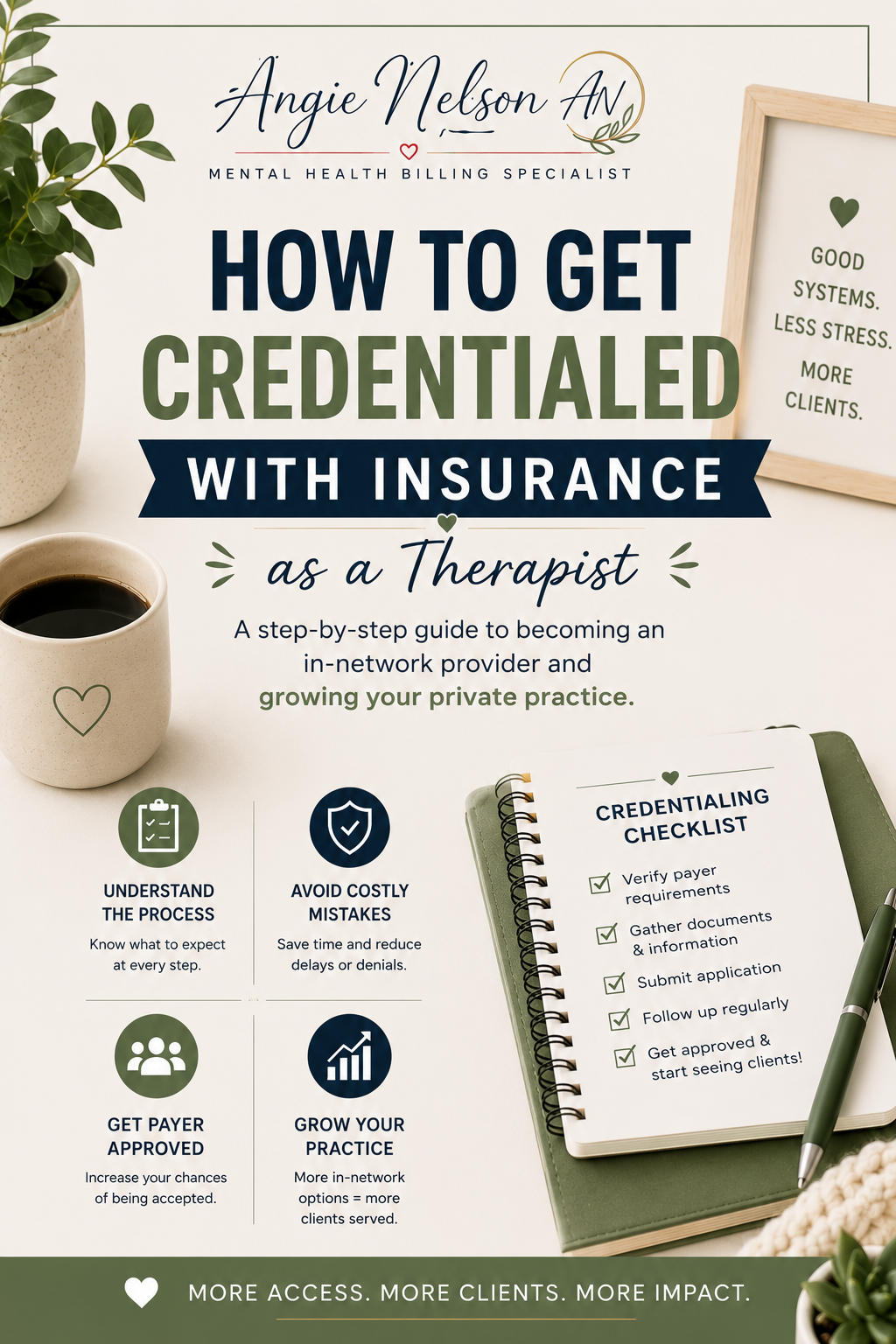
Build a Tracking System From Day One
This might be the single most practical thing I can tell you about credentialing: build a tracking system before you submit your first application, and actually use it.
Credentialing can involve applications to multiple payers at once, each at a different stage of review, each with its own contact, each potentially asking for different follow-up documentation. If you’re tracking that in your head or across scattered email threads, you will lose track of something.
A simple spreadsheet works. What matters is that it exists and that you update it. At a minimum, track:
- Which payer you applied to
- The date you submitted
- Any confirmation number or submission reference
- The contact name and phone number or email you’ve been working with
- What documents you sent and when
- Any follow-up conversations (date, who you spoke with, what was said)
- Current status
- Your effective date once approved
- Whether your contract has been received and signed
That last column — effective date — matters more than most people realize, which brings me to the next point.
Don’t Bill Until You Know Your Effective Date
This is the mistake I see more than almost any other with new practice owners: scheduling and seeing insurance clients before they’ve confirmed their official participation status.
Receiving approval is not the same as having an effective date. And having an effective date is not the same as being ready to bill. Some payers have additional paperwork or steps after approval before you’re officially active in their system. If you start billing before that’s confirmed, claims can be denied in ways that are difficult or impossible to recover.
Before you schedule a single insurance client:
- Confirm your participation status in writing
- Confirm your official effective date
- Confirm whether any additional steps are required before billing
- Keep a copy of your approval letter and any contract you sign
If you’re not sure whether you’re active, call the payer and ask. Don’t assume. The cost of assuming is almost always higher than the cost of one extra phone call.
Following Up Without Losing Your Mind
Credentialing rarely moves quickly. Applications go through multiple review stages. Sometimes things stall for reasons you can’t see from the outside. Following up regularly is part of the process — not a sign that something went wrong.
When you do follow up, keep notes. Write down who you spoke with, when, and what they told you. If a payer rep tells you your application is “under review” or that they need an additional document, document that conversation the same day. This kind of paper trail matters if something gets lost or there’s a discrepancy later.
A few habits that help:
- Set a calendar reminder to follow up if you haven’t heard anything after a few weeks
- Save every confirmation email
- When additional documents are requested, send them promptly and confirm receipt
- Stay professional in every interaction, even when you’re frustrated
Processing timelines are largely outside your control. How you track and respond to the process is not.
Should You Do It Yourself or Hire Someone?
Both options work, and I’ve seen therapists succeed with either approach. The right choice depends on how you’re wired and how much time you realistically have.
Doing It Yourself
DIY credentialing is completely doable, especially if you’re only applying to a handful of payers and you’re comfortable with administrative detail work. The main advantage is visibility — you know exactly where every application stands, and nothing gets filtered through someone else.
The trade-off is time. Credentialing is not a set-it-and-forget-it process. It requires active follow-up, document management, and regular attention. If you’re also launching a practice, that’s a lot to manage at once.
Credentialing 101: A Course That Walks You Through It
If you’re credentialing yourself, the hardest part isn’t filling out the applications. It’s knowing which step comes next, and catching what you missed before a payer sends it back. A structured course fixes that.
Credentialing 101 is Kym Tolson’s credentialing training. Kym is an LCSW and the founder of Bill Like a Boss. She built it for mental health clinicians, not hospital credentialing departments.
You can buy Credentialing 101 on its own. But if you plan to bill insurance yourself, look at Bill Like a Boss first. The credentialing training is already included in the membership, along with everything you’ll need once you’re in network.
What’s included in Bill Like a Boss
- Credentialing training for solo and group practices, plus a separate session on Medicare credentialing
- Guidance on choosing the insurance panels that fit your practice
- Benefits verification guides, recorded example calls, and scripts for talking with insurers
- CPT code cheat sheets and step-by-step claim guides
- 20 practice templates, including superbills, billing consents, sliding scale agreements, and telehealth consents
- Live monthly billers meetings and a private Facebook group for questions
Lifetime members also get a one-on-one systems session. It covers CAQH setup, ERA/EFT enrollment, and NPI organization, which are three of the setup steps people most often get stuck on.
Pricing
- Monthly: $45/month, cancel anytime
- Annual: $450/year
- Lifetime: $1,297 one time, or 3 payments of $500
Why the membership makes more sense than the course alone
Credentialing gets you on the panel. It doesn’t get you paid. Once your effective date comes through, you still have to verify benefits, submit clean claims, and follow up on denials. A credentialing-only course solves one problem and leaves you to figure out the next one by yourself.
With Bill Like a Boss, the credentialing training and the billing system are in the same place. When an application stalls or a claim comes back denied, you have a live meeting to bring it to.
For a closer look at what’s inside and who it fits best, read my full Bill Like a Boss review.
Using a Credentialing Service
Credentialing companies handle most of the administrative work: preparing applications, tracking submissions, following up with payers, and organizing documentation. For therapists who don’t enjoy that kind of work or simply don’t have the bandwidth, outsourcing credentialing can be worth the cost.
One thing worth saying clearly, though: hiring a credentialing service doesn’t mean you can disengage. You should still know where each application stands, have copies of everything submitted on your behalf, and be tracking your own effective dates and contracts. The service handles the legwork. You’re still responsible for knowing the status of your own practice.
Platforms Like Alma and Headway
Some therapists choose to work through group platforms like Headway that assist with certain aspects of joining insurance networks. These platforms vary in what they offer — some help with credentialing workflows, some handle claims submission, some provide access to payer relationships that would be harder to access independently.
They also have their own business models, eligibility requirements, and participating payer lists that vary by state. If you’re considering this route, read carefully to understand what you’re agreeing to and whether it fits your long-term practice goals. It’s not the right fit for everyone, but for some therapists it removes a significant amount of administrative friction.
Alma and Headway aren’t the only options in this space, either. If you’re weighing which credentialing platform fits your practice, our comparison of Alma alternatives breaks down how Headway, Grow Therapy, Rula, SonderMind, and Talkspace differ on fees, referrals, and payer availability.
Common Credentialing Mistakes Worth Avoiding
After working with therapy practices for a while, I’ve seen the same issues come up repeatedly. None of these are catastrophic on their own, but they all slow things down in ways that are usually preventable.
Submitting Incomplete Applications
Missing information is one of the most common reasons applications stall. Before you submit anything, go through every section. A partially completed application often gets sent back rather than flagged for follow-up, which means you’ve lost time you didn’t need to lose.
Letting CAQH Fall Out of Date
If your CAQH profile has expired documents, outdated contact information, or sections that haven’t been re-attested, applications that pull from it can stall mid-review. Check your CAQH profile before you start any application, and check it again periodically even when you’re not actively credentialing. Re-credentialing cycles will come around whether you’re thinking about them or not.
Not Following Up
Applications don’t always move on their own. Payers process a high volume of applications, and yours isn’t necessarily getting special attention. Following up — politely, consistently, and with notes — keeps your application visible and catches problems earlier.
Assuming Approval Without Written Confirmation
If someone at the payer tells you verbally that your application looks good or that approval is coming, that’s encouraging. It’s not confirmation. Wait for something in writing, and don’t schedule insurance clients until you have your official effective date.
Losing Track of Effective Dates and Contracts
Once you’re approved, the administrative work isn’t quite done. Make sure your effective date is recorded, your contract is signed and saved, and you know exactly when you can start billing. These details have a way of getting lost in the post-approval relief of finally being done.
What to Do While You’re Waiting
Credentialing timelines vary. Some payers move faster than others, and some states have longer processing cycles than others. Waiting is part of the process, and it’s genuinely frustrating when you’re eager to open your practice.
The therapists I’ve seen handle this most productively are the ones who treat the waiting period as a runway, not downtime. There’s a lot you can do before your first insurance client walks in the door:
- Get familiar with your EHR — really familiar, not just surface-level
- Set up your billing workflows and fee schedules
- Finalize your intake paperwork and office policies
- Build or refine your website and online presence
- Work on your SEO (insurance-based therapists often underestimate how important this is)
- Develop referral relationships with local providers
- Learn the billing basics: CPT codes, benefits verification, claim submission, EOBs
- Organize your document storage and recordkeeping systems
A practice that’s administratively ready before credentialing is complete can hit the ground running the moment you’re active. One that waited to set everything up until after approval often has a chaotic first few months.
Frequently Asked Questions
How long does therapist credentialing take?
It varies significantly — by payer, by state, by application completeness, and by current processing volume. Some payers move faster than others. Some states have longer review cycles. The honest answer is that it’s hard to predict, which is why starting earlier than you think you need to is almost always the right call. Always verify estimated timelines directly with each payer.
Can I see insurance clients while credentialing is pending?
Policies vary by payer and by practice arrangement. Some payers allow retroactive billing once credentialing is complete; others don’t. Before scheduling any clients as in-network patients, verify your participation status and effective date directly with the insurance company. Don’t assume, and don’t rely on what worked with a different payer.
Do I need to credential with every insurance company separately?
Generally, yes. Each payer has its own participation requirements and application process, and those requirements can differ even within the same state or the same insurance family. There’s no universal application that works across all payers, though CAQH does reduce some of the repetition.
Is credentialing the same as contracting?
Not always. Credentialing is the verification process; contracting is the agreement that establishes your participation terms. Some payers combine portions of both. Others keep them as clearly separate steps. The workflow depends on the payer, so it’s worth asking how their process is structured before you start.
Can I complete credentialing myself?
Many therapists do, especially for a smaller number of payers. Others prefer using a credentialing service, particularly when applying to multiple payers at once or when they’re also managing the rest of a practice launch. The right choice depends on your budget, your available time, and how comfortable you are with administrative detail work. There’s no wrong answer — just the one that fits your situation.
What happens if my application is denied?
Denials happen, and they’re not always permanent. Common reasons include incomplete applications, closed panels, missing documentation, or issues with licensure history. If you’re denied, ask the payer for the specific reason in writing. Some issues are fixable and the application can be resubmitted. Others — like a closed panel — may just require waiting until the payer opens enrollment again. Either way, knowing the reason is the first step.
What’s the difference between an NPI Type 1 and NPI Type 2?
A Type 1 NPI is issued to individual providers — it’s tied to you as a person, and you only ever have one. A Type 2 NPI is issued to organizations or group practices. If you’re operating as a solo practice under a business entity, you may need both. Which NPI goes on which application depends on how you’re enrolled — individual or group — with each payer. When in doubt, ask the payer which NPI they need for your specific enrollment.
Do I need to re-credential after a certain period?
Yes. Most payers require re-credentialing on a regular cycle, typically every two to three years. The process is usually less involved than the initial credentialing, but it does require active participation: updated documents, re-attestation, and timely response to payer requests. Missing a re-credentialing deadline can affect your active participation status, so it’s worth tracking those dates just like you would track initial applications.
Should I apply to every insurance panel at once?
That’s a practice decision more than an administrative one, and it depends on your market, your specialty, and your capacity to manage multiple applications simultaneously. From a purely organizational standpoint: the more applications you have active at once, the more follow-up you’ll need to manage. Some therapists prefer to start with a few priority payers and add others over time. Others apply broadly from the start. Neither is wrong, but going in with a plan is better than applying everywhere at once without a tracking system in place.
Final Thoughts
Credentialing is one of those parts of private practice that nobody really prepares you for in graduate school, and the learning curve can feel steep at first.
What I’ve seen consistently over the years is that the therapists who get through it with the least amount of frustration aren’t necessarily the ones with the smoothest payer experiences. They’re the ones who went in organized, tracked everything, followed up consistently, and didn’t make assumptions about where they stood.
The process itself is largely outside your control. Your documentation, your follow-up habits, and your organizational systems are not.
Start organized. Stay organized. Verify everything in writing. And give yourself more runway than you think you’ll need.
Credentialing is step one of a much longer process. Once you’re in-network, here’s the complete workflow for what happens from the first verified session through final payment.
