

If you’re planning to accept insurance in private practice and you’ve been doing any research at all, you’ve probably come across Alma and Headway.
Both platforms aim to take a significant chunk of the administrative burden off therapists who want to work with insurance — the credentialing paperwork, the claims submission, the payment tracking. For therapists who feel overwhelmed by the billing side of private practice, they can be genuinely appealing.
At first glance, they look nearly identical. In practice, there are real differences in how they operate, what they cost, who they’re designed for, and how they fit into your practice long-term.
I want to be upfront about something before we get into the details: I’m sharing this from my perspective as a biller, not as a therapist. I understand that these platforms have generated real debate in the therapy community — around reimbursement rates, autonomy, the influence of venture-backed companies on the mental health field, and what it means for the profession when a third party sits between a therapist and their insurance contracts. Those are valid and important conversations.
But they’re conversations for therapists to have with each other. My lane is billing and administrative workflows, and that’s where I’ll stay in this comparison. I’m not here to tell you what to think about these platforms from a professional ethics standpoint — only to give you an honest look at how they function.
Platform features, participating insurance networks, fees, and state availability change over time. Always verify current information directly with Alma and Headway before making a decision.
Quick Comparison
| Feature | Alma | Headway |
| Cost to provider | ~$125/month membership | Free for providers |
| Credentialing support | Yes | Yes |
| Claims submission | Yes | Yes |
| Benefits verification | Yes | Yes |
| Private pay support | Yes | Yes |
| Medicare/Medicaid billing | Limited — verify directly | Not supported |
| Can use your own EHR | Yes | Yes |
| Continuing education | Yes | No |
| Professional community | Strong | Limited |
| Client referrals/directory | Yes (varies by market) | Some (varies by area) |
| Multi-state licensing support | Handles CAQH management | Supported; CAQH managed independently |
| Payment speed | Weekly | Within 30 days (varies) |
| State availability | Varies — verify directly | Varies — verify directly |
Information current as of mid-2026. Features, pricing, and availability change frequently. Verify all details directly with each platform before enrolling.
What Are These Platforms, Really?
Both Alma and Headway operate as intermediary platforms between therapists and insurance companies. Instead of going through the full independent credentialing process with each payer on your own, you join the platform — and the platform handles the insurance relationship on your behalf.
That’s a meaningful distinction. When you use either of these platforms, you are participating in the insurance network through them, not as a fully independently credentialed provider with each payer. For many therapists — especially those just starting out or those who never want to manage billing themselves — that arrangement works well. For others who eventually want full independence from any intermediary, it’s worth understanding upfront.
The tradeoff is real on both sides: you get a significantly lower administrative burden, but you are working within their systems and their terms. Whether that’s the right fit is a practice decision only you can make.
You Don’t Have to Give Up Your EHR
One of the questions I hear most often from therapists who are considering these platforms is whether they’ll be forced to switch to a new EHR.
The short answer is no — both Alma and Headway allow you to continue using your own EHR for clinical documentation. You’re not locked into their systems for your notes. The platforms handle the billing and claims side; your EHR can stay exactly where it is.
This matters for a few reasons. If you’ve already built your workflows around a specific EHR — your intake forms, your note templates, your scheduling — you don’t have to rebuild all of that to use one of these platforms. And if you eventually decide to leave the platform and manage billing independently, your clinical records aren’t trapped somewhere you can’t access them.
That said, each platform does have its own portal or dashboard for managing the billing side of things. You’ll be working in two systems to some extent: your EHR for clinical documentation and the platform for billing and insurance administration. For most therapists, that’s a manageable trade-off compared to managing full independent credentialing and billing.
Alma: What It Offers and Who It’s For
Alma is a membership-based platform that combines insurance administration with professional resources. The monthly fee — currently around $125, though this can change — covers credentialing support, claims management, and access to a broader set of tools and community features.
What Alma Brings to the Table
On the billing side, Alma handles credentialing, claims submission, and payment processing. Payments are made on a weekly cycle, which is faster than many independent billing setups.
Beyond the administrative tools, Alma has built out a professional community that includes continuing education, peer consultation, and networking opportunities. For therapists who want more than just billing support from a platform — who are looking for a community and professional development resources — that’s a meaningful differentiator.
Alma also tends to handle multi-state licensing and CAQH credential management more actively than Headway, which makes it potentially more useful for therapists practicing across multiple states via telehealth.
From a user experience standpoint, Alma is generally praised for a clean, intuitive interface that makes claim submission and patient management straightforward.
Where Alma Has Limitations
The monthly membership fee is a real consideration. At around $125 a month, Alma costs money before you see a single reimbursement. That’s not a dealbreaker for an established practice, but it’s a factor worth thinking through if you’re just starting out.
Alma’s insurance network tends to be stronger for commercial and private pay clients. Its in-network billing options are more limited compared to Headway, which means it may not cover all the payers you want to work with depending on your state and population. Verify the current payer list for your location before committing.
Setup and onboarding can also involve a steeper learning curve for providers who aren’t already comfortable with insurance workflows.
Best Fit for Alma
Alma tends to be a better fit for therapists who value professional community and ongoing education alongside the administrative support, who are building a larger insurance-based caseload and can absorb the monthly membership cost, or who practice across multiple states and want CAQH management handled for them.
Headway: What It Offers and Who It’s For
Headway is free for providers. There’s no monthly membership fee, which is one of the first things therapists notice when they’re comparing the two. The platform makes its money through a percentage of each reimbursed claim, not through a subscription — though the specific terms vary and are worth reviewing carefully before you sign up.
What Headway Brings to the Table
Headway focuses on streamlining the insurance workflow from end to end: credentialing support, benefits verification, claims submission, and payment tracking. The interface is clean and the setup process is straightforward, which is why it’s often the first platform new-to-insurance therapists encounter.
In terms of insurance coverage, Headway tends to have broader in-network options across major commercial payers than Alma, which makes it a stronger choice for therapists who want maximum insurance flexibility.
Headway also integrates with external calendars like Google Calendar and Outlook, which helps with scheduling workflows if you’re managing your own calendar alongside the platform.
In my billing work with private practices, Headway is the platform I’ve encountered most frequently. That’s anecdotal — it doesn’t mean it’s the right fit for every practice — but it does reflect how commonly it’s used among solo therapists who are newer to insurance billing and want to reduce administrative overhead without taking on a monthly cost.
A Common Use Case Worth Mentioning
One pattern I’ve seen repeatedly with practices I support: therapists use Headway while their own independent credentialing is still in process. Because Headway can often get providers billing sooner through their network, it’s sometimes used as a bridge — a way to start seeing insurance clients before individual payer contracts are finalized.
Whether that approach is available or appropriate in your situation depends on the platform, the specific payers, your state, and your practice setup. It’s not a guarantee, and it’s not right for everyone. But it’s a real-world use case that comes up enough that it’s worth understanding.
Where Headway Has Limitations
Headway does not support Medicare or Medicaid billing. If any portion of your caseload involves government payers, you’ll need a separate solution for those claims.
Headway also doesn’t offer continuing education or a professional community in the way Alma does. If that kind of support matters to you, Headway won’t provide it.
Some therapists also note that Headway’s customer support, while generally adequate for routine issues, can be slower to resolve more complex billing problems. That’s not unusual for a platform at this scale, but it’s worth knowing if you tend to have more complicated insurance situations.
Best Fit for Headway
Headway tends to work well for solo therapists who want a no-cost way to start accepting insurance without managing the full credentialing and billing process independently, who are working primarily with commercial payers, and who prioritize a clean, simple administrative experience over broader professional resources.
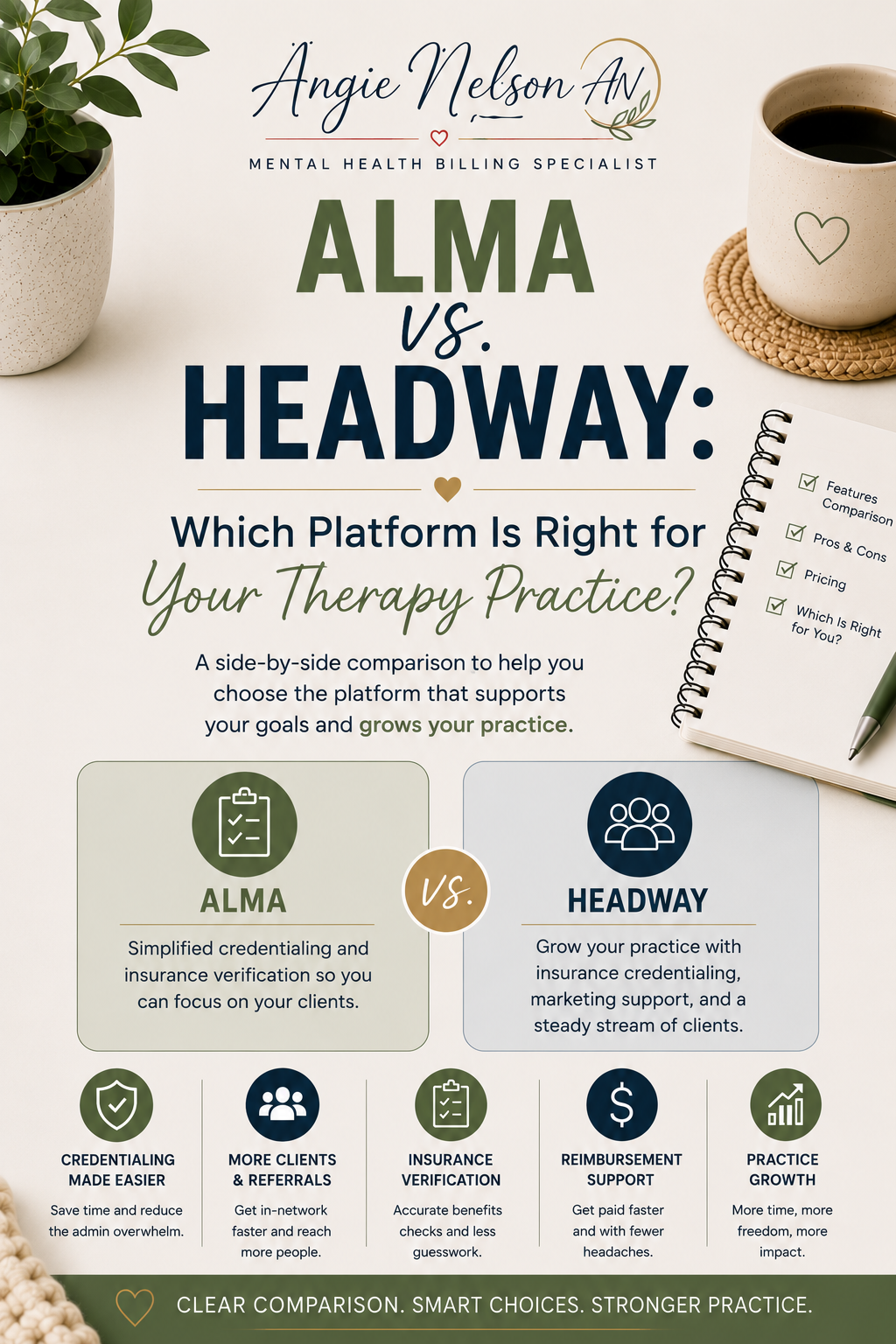
Comparing What Actually Matters Day to Day
Billing and Claims
Both platforms handle claims submission, payment processing, and benefits verification. From a pure billing mechanics standpoint, they’re more similar than different. The main practical distinction is that Headway pays biweekly while Alma pays weekly — which can matter for cash flow, especially in a newer practice.
Neither platform is designed for Medicare, Medicaid, or TRICARE billing. If any of those payers are part of your caseload, you’ll need independent credentialing and billing outside of these platforms.
EHR and Documentation
As noted earlier, both platforms allow you to use your own EHR. Neither requires you to switch your clinical documentation system. You’ll manage notes in your EHR and billing through the platform’s dashboard.
This is different from some other platforms (like Grow Therapy and Rula) that require you to duplicate notes within their system, which adds time and creates record-keeping complexity. The EHR flexibility that both Alma and Headway offer is genuinely useful and worth factoring into any comparison.
Credentialing Support
Both platforms help with credentialing, but neither guarantees approval or a specific timeline. Panel availability varies by payer and state. Processing times vary. And — importantly — the insurance contracts are ultimately held by the platform, not by you individually. Understanding that distinction matters if you ever plan to transition to independent billing.
Client Referrals and Visibility
Both platforms offer some form of provider directory or client matching, but availability varies significantly by location, specialty, and payer participation. Neither platform guarantees referrals or a full caseload. Most therapists using either platform still rely on their own marketing, websites, and referral networks to build their client base.
Professional Community and Development
This is where the platforms diverge most clearly. Alma has built out a meaningful professional community with continuing education, peer consultation, and networking. If you’re looking for that kind of support alongside billing administration, Alma is the better choice. Headway doesn’t offer this.
A Note on the Broader Conversation About These Platforms
I want to briefly acknowledge something, because I think it would be dishonest to write about Alma and Headway without mentioning it.
There is real and ongoing debate in the therapy community about what these platforms mean for the profession. Concerns include reimbursement rates that some therapists find lower than what they could negotiate independently, the implications of having a venture-backed company sitting between therapists and their insurance relationships, questions about data use and business model transparency, and broader questions about what this kind of intermediary model means for therapist autonomy over time.
I’m not in a position to weigh in on those debates as a biller. Those are clinical and professional ethics questions that belong to therapists, their professional associations, and the field itself. There are thoughtful arguments on multiple sides, and I’d encourage you to seek out those conversations in therapist communities and professional publications if you haven’t already.
What I can say from my lane: both platforms function as billing and administrative tools. They can reduce overhead for practices that use them as intended. Whether the broader trade-offs are acceptable is a question only you can answer.
Can You Eventually Leave These Platforms?
Yes — and some therapists do. Using a platform like Alma or Headway doesn’t lock you in permanently, though transitioning out does take planning.
Because your insurance contracts are held through the platform rather than individually, leaving means going through the full independent credentialing process with any payers you want to maintain. That takes time — often several months — and requires the same organizational preparation as initial credentialing.
The transition tends to go most smoothly when therapists plan it in advance: starting the independent credentialing process before leaving the platform so there’s no gap in insurance billing coverage, and making sure they have their own billing systems (EHR with billing capabilities or a separate billing service) in place before the switch.
Some therapists use these platforms indefinitely as a long-term administrative solution. Others use them as a starting point while they build their practice and then transition to full independence. Both are valid paths.
Frequently Asked Questions
Do Alma and Headway credential therapists directly with insurance companies?
Both platforms assist with credentialing, but the insurance contracts are typically held by the platform on your behalf rather than established directly in your name. This is an important distinction if you ever plan to bill independently. Always verify how the credentialing arrangement is structured before signing up.
Can I use my own EHR with Alma or Headway?
Yes. Both platforms allow you to continue using your own EHR for clinical documentation. You’ll manage notes in your EHR and handle the billing and insurance side through the platform’s dashboard. You are not required to switch EHR systems to use either platform.
Does Headway charge therapists a fee?
Headway does not charge a monthly membership fee to providers. The platform takes a percentage of reimbursed claims instead. Alma charges a monthly membership fee, currently around $125, though pricing can change. Always review current fee structures directly with each platform before enrolling.
Do these platforms work with Medicare and Medicaid?
Headway does not support Medicare or Medicaid billing. Alma’s government payer support is limited — verify directly with them for current details. If Medicare or Medicaid patients are part of your practice, you’ll need to handle those payers through independent credentialing and billing outside of these platforms.
Which platform is available in my state?
Both platforms are available in multiple states, but availability varies and changes over time. Neither operates in every state. Always verify current state availability directly with each platform before starting an application.
Can I use both platforms at the same time?
Technically, some therapists do use multiple platforms, though it adds administrative complexity and may create conflicts depending on how payer relationships are structured through each. If you’re considering this, review each platform’s terms carefully and verify there are no exclusivity provisions with the specific payers you’re working with.
Will joining one of these platforms help me build my caseload faster?
Both platforms offer some form of provider directory or client matching, but referral availability varies significantly by location, specialty, and payer. Neither platform guarantees a full caseload or a specific number of referrals. Most therapists using these platforms still rely primarily on their own marketing and referral networks. The main value is administrative — not client acquisition.
What happens to my insurance billing if I leave one of these platforms?
Because the insurance contracts are typically held through the platform rather than independently in your name, leaving means you’ll need to go through independent credentialing with any payers you want to continue billing. That process takes time. The smoothest transitions happen when therapists start the independent credentialing process before they leave the platform, so there’s no gap in insurance billing coverage.
Which platform do most therapists use?
Usage varies by region and specialty. In my billing work supporting private practices, Headway is the platform I’ve encountered more frequently — particularly among solo therapists who are newer to insurance billing. But that’s anecdotal and reflects my specific client base, not industry-wide data. Both platforms are widely used.
Final Thoughts
Both Alma and Headway can genuinely reduce the administrative burden of accepting insurance in private practice. For therapists who don’t want to manage the full credentialing and billing process independently, either platform can be a reasonable solution depending on your goals.
From what I’ve seen in practice, Headway tends to be the more common starting point for solo therapists who want to accept insurance without overhead costs and without deep billing expertise. Its broader in-network commercial options and no-cost model make it practical for a lot of practices, especially early on.
Alma is worth the monthly fee if you’re looking for a professional community, continuing education, and the additional support beyond billing — and if the payer network in your state covers the clients you want to serve.
The right answer depends on where you are in your practice, what you value in a platform, and what your long-term plans look like for billing and insurance management. Take both platforms’ current information at face value, ask the questions this post raised directly with each one, and make the decision that fits your practice — not someone else’s.
And if neither Alma nor Headway ends up being the right fit — maybe you want more referrals, or neither has strong payer coverage in your state — they aren’t the only credentialing platforms out there. Our roundup of Alma alternatives covers Grow Therapy, Rula, SonderMind, and Talkspace, with an honest look at how each handles fees, referrals, and credentialing.
This comparison is written from a billing and administrative perspective. For clinical, professional, or ethical considerations about these platforms, consult your professional association or peer communities in the therapy field.
