

Jane App has a well-deserved reputation in the multidisciplinary healthcare space. Clean interface, solid scheduling, flexible charting. If you’re a therapist in a multidisciplinary clinic, or you’re practicing in Canada, it’s probably on your shortlist for good reasons.
But if you’re a US-based therapist billing insurance, Jane’s roots show in ways that matter. It wasn’t built for solo therapy practices or for the US commercial insurance market specifically. Insurance billing requires a third-party clearinghouse add-on. The mental health–specific documentation depth isn’t as deep as purpose-built platforms. And the pricing, once you add everything a US insurance-billing practice needs, ends up at $100 or more per month.
That’s not a reason to dismiss Jane if it works for your practice. But it is a reason to look at the alternatives, particularly if billing insurance is a significant part of how you operate.
This guide covers the six best Jane App alternatives for therapists in 2026 — with real 2026 pricing, honest assessments of each platform’s strengths and limitations, and a clear recommendation based on what your practice actually needs.
Pricing and features change frequently. Always verify current plan details directly with each vendor before purchasing. Pricing in this post reflects mid-2026 published information.
Why Therapists Look for Jane App Alternatives
Jane is genuinely good at what it was designed for: a clean, flexible practice management system for multi-discipline clinics. Where it runs into friction for US-based therapy practices is largely structural:
- Insurance billing requires a third-party clearinghouse subscription (typically Claim.MD at $25–49/month) on top of Jane’s plan cost, adding both expense and setup complexity
- Jane doesn’t have a free trial — evaluating it before committing requires relying on demos and third-party reviews rather than hands-on testing
- Mental health–specific note templates are available but not as deep as platforms built exclusively for behavioral health
- The interface, while polished, is designed for a broader healthcare audience — some therapists find it more flexible than they need and more complex to set up than platforms with narrower focus
- Jane is priced competitively for multi-discipline clinics but is comparable to or higher than purpose-built therapy platforms when you factor in all-in costs
None of these are reasons Jane is a bad platform. They’re reasons a solo therapist billing commercial insurance in the US might find a purpose-built alternative fits their workflow better.
What to Actually Look for in a Jane Alternative
Before you start comparing platforms, it’s worth being specific about which features matter most to your practice. An EHR that’s excellent for a private-pay yoga therapist is different from one that’s excellent for a solo LPC billing Aetna and BCBS.
For Insurance-Billing Practices, Prioritize:
- Integrated claim submission (built-in clearinghouse, not a separate subscription)
- ERA posting and payment reconciliation
- Eligibility verification — ideally with real-time checks before sessions
- Denial management workflow and AR reporting
- Insurance-specific documentation templates that support medical necessity
For Cash-Pay or Mixed Practices, Prioritize:
- Clean client portal with self-scheduling and paperless intake
- Reliable telehealth that clients can join without friction
- Payment collection and superbill generation
- Documentation flexibility and note template quality
Use the comparison that follows through that lens — what matters most to your specific practice, not what has the most features overall.
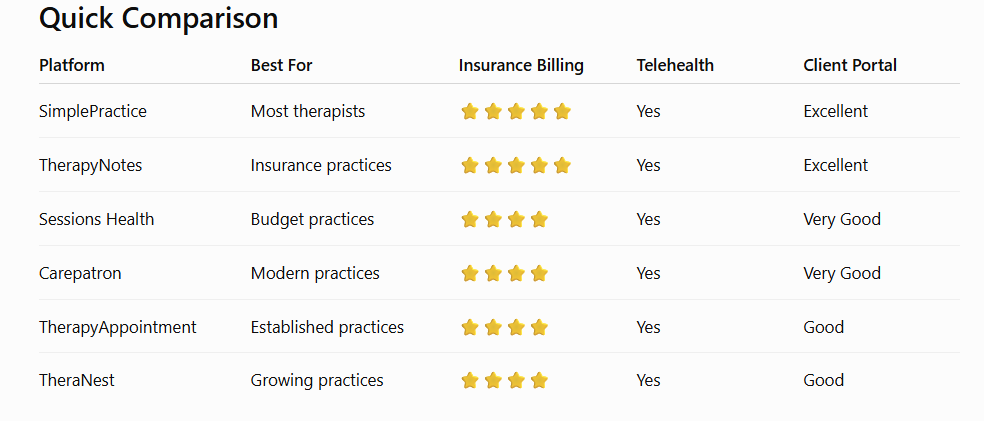
Quick Comparison: Jane App Alternatives (2026)
| Platform | All-In Price (Solo) | Insurance Billing | Free Trial | Best For |
| SimplePractice | $69/mo (Essential); $0.25/claim | Built-in; excellent | 30 days | Most US solo practices billing insurance |
| TherapyNotes | $69/mo solo; $0.14/claim | Built-in; excellent | 21 days | Insurance-heavy practices; strong AR reporting |
| Sessions Health | $39/mo base; $10/mo telehealth add-on | Built-in; $0.19–0.25/claim | Free tier (3 clients) | Budget-conscious solo practices |
| Carepatron | Free tier; paid from ~$14.50–$29/mo | Add-on; per-claim fee | Free plan + 30-day trial | New practices; private pay; multi-discipline |
| TherapyAppointment | $10/mo (0–10 sessions); $39/mo (11–39) | Built-in; all tiers | Yes | New practices; budget; all features at every tier |
| TheraNest (Ensora) | $42–$98+/mo based on client volume; telehealth $12/mo add-on | Built-in; $0.17–0.23/claim | 21 days | Mid-size and growing practices; high customization |
| Jane App (for reference) | ~$79/mo Practice + ~$25–49/mo clearinghouse | Requires 3rd-party clearinghouse | No trial | Multi-discipline clinics; Canadian practices |
Pricing verified mid-2026. Always confirm current rates directly with each vendor before purchasing. All-in price for insurance billing includes clearinghouse fees where applicable.
1. SimplePractice — Best overall for most US therapists billing insurance
SimplePractice is the most widely used EHR among US-based solo and small group therapy practices, and it’s the alternative I recommend most consistently for therapists switching from Jane — particularly those who bill insurance.
The reason is straightforward: SimplePractice was built exclusively for mental health and behavioral health providers. The documentation templates, the billing workflow, the client portal, the telehealth — all of it was designed for the therapy session lifecycle, not repurposed from a broader healthcare template. That specificity shows in daily use.
Insurance Billing
This is where SimplePractice has its clearest edge over Jane for US therapists. Insurance billing is fully integrated: claim submission, ERA posting, payment reconciliation, eligibility verification, and AR reporting all live in the same platform where you do everything else. There’s no separate clearinghouse subscription to manage. Claims go out through SimplePractice’s built-in clearinghouse at $0.25 per claim, and the billing workflow is well-suited to the volume a solo or small group practice generates.
In my billing work with multiple therapy practices, SimplePractice is the EHR I encounter most often — and the billing side holds up in real-world use. ERAs post cleanly, the aging report is useful, and the denial workflow is logical. It’s not perfect, but it’s the most integrated option available for a practice that’s billing commercial insurance.
Client Portal and Telehealth
SimplePractice’s client portal is consistently cited as one of its strongest features. Intake forms, consent documents, scheduling, telehealth access, secure messaging, and payment all work together cohesively. Clients join telehealth sessions from their browser without downloading anything. The reminders connect to scheduling automatically. For many therapists, this is the first professional impression clients get of the practice.
What to Watch For
The Starter plan at $29/month sounds attractive but excludes telehealth, calendar sync, and insurance billing — the features most therapists actually need. The realistic floor for an insurance-billing practice is the Essential plan at $69/month plus clearinghouse fees. Add the AI Note Taker ($35/month) if you want it, and you’re at $100–$115/month all in. SimplePractice has also raised prices over the years with less notice than some therapists would like.
Pros
- Built exclusively for mental health — every feature designed around therapy workflows
- Most mature integrated insurance billing of any solo-practice EHR
- Excellent client portal; reliable browser-based telehealth
- Psychology Today direct integration
- 30-day free trial
Cons
- Realistic cost for insurance billing is $69/mo+ — not the $29 Starter
- AI Note Taker is a $35/mo add-on, not included
- Less customizable than Jane for non-standard workflows
Pricing
$29/mo Starter (excludes telehealth, insurance billing). $69/mo Essential (most insurance billers). $99/mo Plus. Clearinghouse: $0.25/claim.
Best for
Solo therapists billing commercial insurance in the US who want an all-in-one platform with minimal setup complexity.
2. TherapyNotes — Best for insurance-heavy practices and strong AR reporting
TherapyNotes is purpose-built for behavioral health and has been one of the most trusted EHRs in the mental health space for years. Its reputation is built on two things: rock-solid billing and genuinely responsive customer support. For practices that bill insurance consistently and care more about reliability than polish, it’s a strong alternative to Jane.
Insurance Billing
TherapyNotes’ billing workflow is excellent. Claims submission, ERA posting, payment reconciliation, and AR reporting are all built in and connect directly to the documentation side of the platform. The per-claim fee is $0.14 — lower than SimplePractice’s $0.25 — which matters for high-volume practices. Premium Telehealth (HD video, additional features) is a $15/month add-on on top of the $69/month base, but the standard telehealth included at the base price is functional for most use cases.
Documentation
TherapyNotes’ documentation templates are built for behavioral health — the note formats, the assessment tools, the treatment plan structures all make sense in a therapy context without requiring custom builds. The co-signing workflow for supervised clinicians is one of the better implementations in the space, which makes it particularly useful for group practices with interns or associates.
What to Watch For
TherapyNotes’ interface feels more utilitarian than SimplePractice’s. It’s not hard to use — the navigation is logical and consistent — but it doesn’t have the visual polish of newer platforms. If the client portal experience and first-impression aesthetics matter to you, that’s worth evaluating during the trial. Customer support is consistently praised and is one of TherapyNotes’ strongest differentiators.
Pros
- Outstanding integrated billing workflow; lowest per-claim fee at $0.14
- Excellent documentation built for behavioral health
- Strong AR reporting; useful for practices tracking insurance reimbursements
- Best-in-class customer support
- Solid co-signing workflow for supervised clinicians
Cons
- Interface is functional but not visually modern
- Premium telehealth (HD) requires a $15/mo add-on
- Less customizable than Jane or TheraNest for practices with non-standard workflows
Pricing
$69/mo Solo plan. Premium Telehealth: $15/mo add-on. Claims: $0.14 each. AI Scribe: $40/mo add-on.
Best for
Insurance-focused solo and group practices who prioritize billing workflow reliability and responsive support over interface aesthetics.
3. Sessions Health — Best budget all-in-one for solo therapists
Sessions Health has built a loyal following in a short time by doing something unusual in the EHR space: holding the line on pricing while continuing to add features. At $39/month base plus $10/month for telehealth, it offers a complete EHR and telehealth solution at $49/month — about half the cost of SimplePractice Essential and well below Jane’s all-in price for US insurance billing.
What You Get
The core platform includes scheduling, clinical documentation, a client portal, secure messaging, billing tools, and insurance claim submission at a per-claim rate. The interface is clean and modern, onboarding is straightforward, and the platform has been notably stable on pricing in a space where annual increases have become routine. Customer support receives consistently positive reviews, which matters when you’re troubleshooting a billing issue on your own.
Where It Has Limits
Sessions Health has fewer third-party integrations than SimplePractice or TherapyNotes, and the billing reporting is less robust for practices with complex payer mixes or high claim volumes. It also has a smaller user community, which means fewer peer resources and third-party training materials if you run into questions. Electronic claims run $0.19–$0.25 per claim depending on volume — higher than TherapyNotes but comparable to SimplePractice.
Pros
- $49/month all-in for EHR + telehealth — genuinely hard to beat
- Clean, modern interface; fast onboarding
- Integrated billing with per-claim electronic claims
- Consistently stable pricing — no frequent plan changes
- Free plan available (up to 3 active clients)
Cons
- Fewer third-party integrations than larger platforms
- AR reporting less robust for high-volume insurance practices
- Smaller user community; fewer peer resources
Pricing
Free (up to 3 clients). $39/mo base. Telehealth add-on: $10/mo. Claims: $0.19–0.25 each.
Best for
Budget-conscious solo therapists who want a clean all-in-one platform without paying SimplePractice or TherapyNotes prices. Excellent value for practices with moderate insurance volume.
4. Carepatron — Best free entry point; strong for private pay and multi-discipline
Carepatron is the only platform on this list with a genuinely functional free tier. Scheduling, documentation, a client portal, and telehealth are all available at no cost for unlimited clients. For a therapist who is just starting a practice, building a private-pay caseload, or not yet ready to commit to a monthly EHR subscription, that’s a meaningful differentiator.
Paid plans start at approximately $14.50/month on annual billing — significantly less than any other platform on this list with comparable features. AI documentation is included in paid plans rather than offered as a paid add-on, which is another genuine advantage if AI scribing is something you plan to use.
What to Know About Insurance Billing
Carepatron supports insurance billing, but through an add-on per-claim model rather than a seamlessly integrated workflow. For practices with high insurance volume, the billing experience is less mature than SimplePractice or TherapyNotes. Some features that are built-in elsewhere require additional configuration in Carepatron.
Telehealth Reliability
This is worth flagging separately. Multiple independent user reviews have noted reliability issues with Carepatron’s telehealth platform — clients not appearing in the waiting room, difficulty joining sessions. Carepatron is actively working on these issues, but they appear consistently enough in reviews to be worth verifying during a trial before making telehealth a core part of your workflow on this platform.
Pros
- Genuine free plan with unlimited clients, scheduling, documentation, and telehealth
- Paid plans from ~$14.50/mo — most affordable paid option on this list
- AI scribe included in paid plans, not an add-on
- Modern interface; flexible documentation templates
- 30-day trial on paid plans
Cons
- Insurance billing is less mature; add-on model rather than built-in
- Telehealth reliability has been flagged by users — test thoroughly before committing
- Not designed specifically for mental health; some workflows feel generic
- AR reporting and billing analytics are limited
Pricing
Free plan (unlimited clients). Paid: ~$14.50–$29/mo (annual). Insurance claims: per-claim add-on fee.
Best for
New practices, private-pay or cash-pay therapists, and multi-discipline practices who want low or no cost entry with room to grow. Insurance-heavy practices will likely find the billing workflow limiting.
5. TherapyAppointment — Best for new practices watching every dollar
TherapyAppointment doesn’t get as much attention as the other platforms on this list, but it has a loyal user base for a specific reason: every feature is included at every pricing tier, with no upsells. At $10/month for therapists seeing fewer than 10 clients and $39/month for up to 39 sessions, it’s one of the most transparent pricing structures in the space.
Scheduling, documentation, insurance billing, client portal, and appointment reminders are all included at the base price. Telehealth is handled through Zoom integration rather than a built-in video platform, which is worth knowing if you prefer a fully integrated telehealth experience.
What to Know About the Interface
TherapyAppointment’s interface is older and hasn’t kept pace with what newer platforms look like. It’s not difficult to use — the core workflows are logical — but therapists who value a modern, visually polished experience will notice the difference immediately compared to SimplePractice, Sessions Health, or Carepatron. For therapists who care more about what’s included than how it looks, that trade-off may be acceptable, especially at the lower price point.
Pros
- All features included at every tier — no upsells or paywalled upgrades
- $10/mo for practices just starting out; scales predictably
- Insurance billing included at all tiers
- Transparent, straightforward pricing
Cons
- Older interface — less polished than modern platforms
- Telehealth via Zoom integration rather than built-in video
- Smaller development roadmap; fewer new features relative to competitors
Pricing
$10/mo (0–10 sessions). $39/mo (11–39 sessions). Higher tiers available for larger caseloads. All features included at every tier.
Best for
Therapists in the early stages of building a practice who want fully functional billing at minimal cost and don’t prioritize interface aesthetics.
6. TheraNest (now Ensora Mental Health) — Best for growing group practices needing customization
TheraNest is worth mentioning with an important context note: it has been rebranded as Ensora Mental Health under its current ownership by Ensora Health (a KKR portfolio company). If you’re searching for TheraNest and finding references to Ensora, they’re the same platform.
Historically, TheraNest built its reputation on customization — its Dynamic Forms builder allows practices to create highly tailored intake forms, progress notes, and assessment templates. That flexibility is still its strongest differentiator, particularly for group practices with complex documentation workflows or multiple service types.
Pricing Model
TheraNest uses a client-volume pricing model rather than a per-therapist model: you pay based on the number of active clients in your system, not the number of providers. Plans run approximately $42/month for up to 30 clients and $98+/month for 80+ clients. Telehealth is a $12/month per-therapist add-on. Electronic claims run $0.17–$0.23 each. Unlike most EHRs, adding additional therapists to the platform doesn’t increase the subscription cost — which makes TheraNest comparatively cost-effective for group practices with multiple providers.
What the Ownership Change Means
The Ensora Health / KKR ownership has prompted some existing TheraNest users to evaluate alternatives, particularly given concerns about pricing trajectory under private equity ownership. If you’re considering TheraNest as a new user, the platform itself remains functional and actively maintained. The AI Session Assistant (included on the Premier plan) generates progress notes from session recordings and is one of the more substantive AI documentation implementations in the therapy EHR space. Whether the ownership situation is a concern is a judgment call worth factoring into a long-term platform decision.
Pros
- Highly customizable documentation — best Dynamic Forms builder in this comparison
- Per-client rather than per-therapist pricing is cost-effective for multi-provider groups
- AI Session Assistant on Premier plan is substantive
- 21-day free trial; responsive customer support
- No additional cost per therapist added to the practice
Cons
- Client-volume pricing can become expensive as caseload grows
- Telehealth is a $12/mo per-therapist add-on
- Private equity ownership (Ensora/KKR) raises long-term pricing trajectory concerns for some users
- Steeper learning curve than SimplePractice for new users
Pricing
$42/mo (up to 30 clients) to $98+/mo (80+ clients). Telehealth: $12/mo per therapist. Claims: $0.17–0.23 each. Annual billing saves 15%.
Best for
Mid-size and growing group practices that need highly customizable documentation workflows and want per-client rather than per-provider pricing.
Which Jane Alternative Is Right for Your Practice?
| If you… | Consider… |
| Bill insurance regularly and want an integrated, purpose-built workflow | SimplePractice (Essential plan) or TherapyNotes. Both are built for US insurance billing and don’t require a third-party clearinghouse. |
| Prioritize billing reliability and strong AR reporting over modern design | TherapyNotes. Lower per-claim cost, excellent billing tools, best-in-class support. |
| Want to minimize monthly software costs | Sessions Health ($49/mo all-in) or Carepatron (free to start, from $14.50 paid). Both are meaningfully less expensive than SimplePractice or Jane. |
| Are just starting a practice and want to try before committing to any subscription | Carepatron (free plan) or TherapyAppointment ($10/mo entry). Both allow you to get started at minimal cost. |
| Run a growing group practice with multiple providers and need customizable workflows | TheraNest (Ensora). Per-client rather than per-therapist pricing, strong customization, and a co-signing workflow built for supervised clinicians. |
| Primarily see private-pay clients and want affordability + modern interface | Sessions Health or Carepatron. Both are cost-effective and clean without the billing complexity you don’t need. |
| Are in a multi-discipline clinic or practicing in Canada | Jane may still be the right fit. None of the US-focused alternatives match Jane’s strength in multi-discipline or Canadian provincial billing contexts. |
Before You Switch: What to Think Through
Switching EHRs is manageable but takes planning. A few things worth thinking through before you commit to a new platform:
Data Export and Migration
Confirm what you can export from Jane before you start. Clinical notes, intake forms, billing history — the format and completeness of exports vary, and not every EHR can import every file type cleanly. Run a test export from Jane before you’re under time pressure. Ask the new platform specifically what they can import and what you’ll need to re-enter manually.
Timing
If you bill insurance, the cleanest time to switch is when your outstanding claims are resolved and your AR is current. January is a common switching point because it coincides with new plan years. Avoid switching during a stretch when you’re seeing high volume or onboarding new clients.
Client Communication
If your portal changes, clients will need to re-register. Give adequate notice — at least two weeks — and walk clients through any changes to how they schedule, access their records, or receive reminders. Clients who have been with you for years don’t always handle portal changes gracefully; a brief explanation goes a long way.
Use the Free Trials
Every platform on this list except Jane offers a free trial or a free plan. Use them. Don’t evaluate EHRs from feature lists and marketing pages alone. Log in, go through the full billing workflow, post a test payment, run an aging report, and send a test intake form through the client portal. The 20 minutes you spend actually using the platform tells you more than any comparison article — including this one.
Frequently Asked Questions
Which Jane App alternative has the best insurance billing?
SimplePractice and TherapyNotes are both significantly stronger than Jane for US insurance billing because the billing is fully integrated rather than requiring a third-party clearinghouse. Between the two, TherapyNotes has a lower per-claim fee ($0.14 vs $0.25) and is often preferred for high-volume insurance practices. SimplePractice has a more polished interface and the Psychology Today integration. Both are strong choices; the right one depends on whether you value billing efficiency or interface experience more.
Is there a free Jane App alternative?
Yes. Carepatron has a genuinely functional free plan that includes unlimited clients, scheduling, documentation, telehealth, and a client portal. Sessions Health has a free plan for up to 3 active clients. TherapyAppointment starts at $10/month, not free, but is the lowest-cost paid option with a full feature set. If cost is the primary concern, Carepatron’s free plan is the strongest starting point.
Does Jane App have a free trial?
No. Jane does not offer a free trial, which is one of the most commonly cited friction points for therapists evaluating it. Every alternative on this list either offers a free trial or a free plan, which makes hands-on evaluation significantly easier.
Is TheraNest still available or has it been discontinued?
TheraNest is still available but has been rebranded as Ensora Mental Health under its current ownership by Ensora Health (backed by KKR). The platform is actively maintained and continues to receive updates, including the AI Session Assistant. Some existing users have expressed concern about the private equity ownership trajectory, but the product itself is operational. If you’re evaluating it as a new user, search for both “TheraNest” and “Ensora Mental Health” to find current information.
Can I use SimplePractice instead of Jane if I’m not US-based?
SimplePractice is designed primarily for US-based practices. Its insurance billing, credentialing tools, and payer integrations are US-specific. If you’re practicing in Canada or another country, Jane’s broader international support and Canadian provincial billing capabilities make it a stronger fit than US-focused alternatives.
How difficult is it to switch from Jane to another EHR?
Manageable, with planning. Export your data from Jane before you start and confirm what format it comes in. Ask the new platform what they can import. Expect to re-enter some information manually — particularly billing configuration and payer settings. The cleanest transitions happen when AR is current, the switch is timed to a natural break point (start of year, slow season), and clients are given adequate notice about portal changes.
Final Thoughts
Jane App is a well-built platform. If it’s working for your practice, especially if you’re in a multi-discipline setting or practicing in Canada, there may not be a compelling reason to switch.
But if you’re a US-based therapist billing commercial insurance who has been frustrated by the clearinghouse add-on requirement, the lack of a free trial, or the pricing relative to purpose-built alternatives — the options have genuinely improved. SimplePractice and TherapyNotes both offer more integrated insurance billing at comparable or lower all-in costs. Sessions Health and Carepatron offer meaningfully lower pricing for practices where the billing complexity is lighter. And TherapyAppointment offers everything-included at entry-level pricing that Jane can’t match.
The best way to evaluate any of them is to actually use them. Every platform on this list offers a trial or a free plan. Take two or three for a test drive specifically on the workflows that matter most to your practice — billing, documentation, and the client portal experience. That’s the most reliable way to find the right fit.
