

Over the past five years, I’ve seen the demand for remote administrative support in therapy practices grow steadily, and it’s not slowing down. As more therapists build private practices, expand telehealth services, and take on insurance billing, the administrative side of their businesses grows with it — and most of them would rather spend that time with clients.
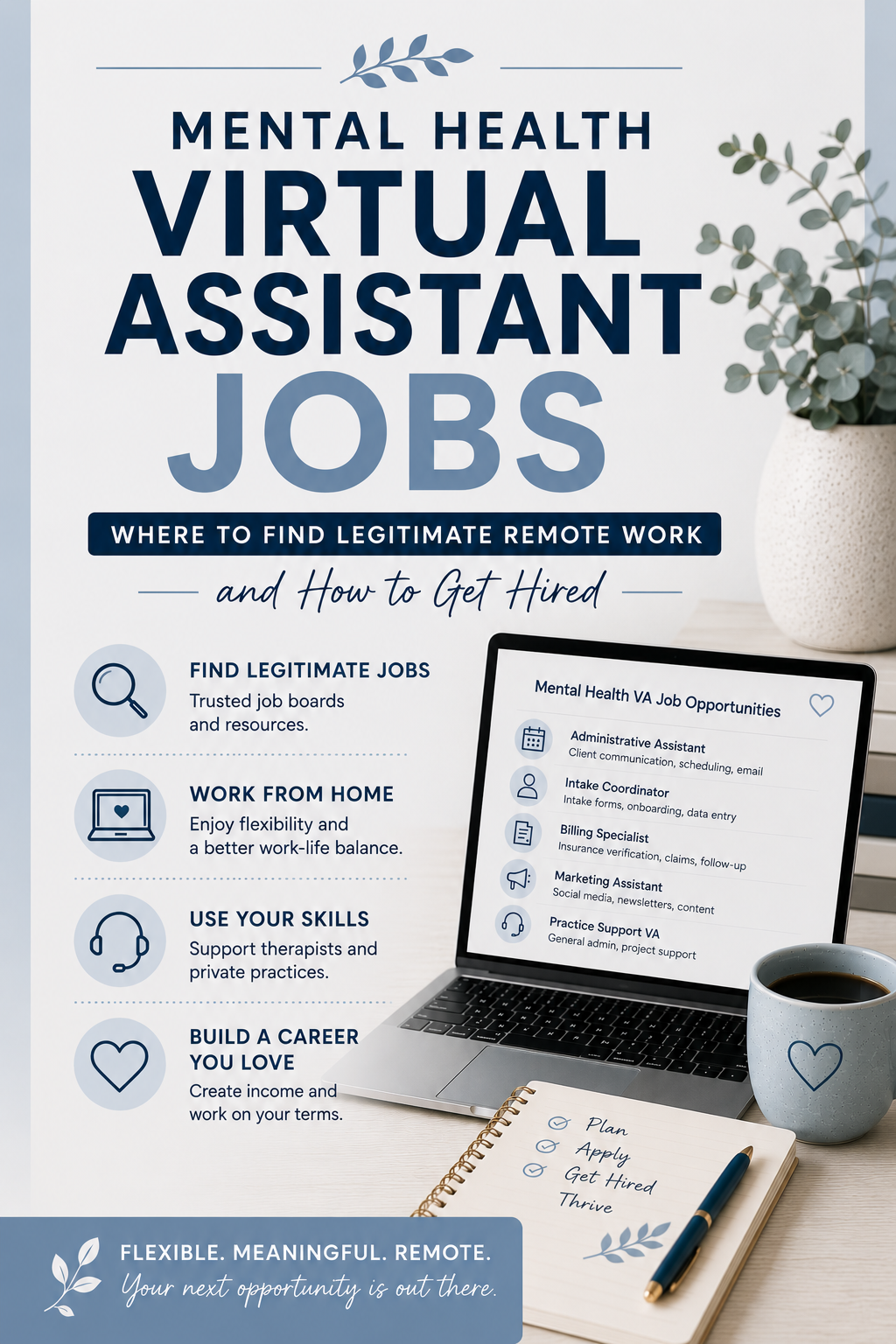
Mental health virtual assistant work sits at an interesting intersection: it’s remote, it’s meaningful, it pays more than general VA work when you have the right skills, and it’s genuinely in demand. It’s also more specific than most job listings make it sound. Therapists aren’t looking for someone who can manage a generic inbox — they’re looking for someone who understands their workflows, can handle sensitive information professionally, and won’t require months of hand-holding to be useful.
This guide covers everything you need to know based on my own personal experience as a Virtual Assistant for almost 20 years: what the work actually looks like day to day, what skills matter, what the job pays, where to find legitimate opportunities, how to evaluate postings before you apply, and how to build your own client base if that’s where you eventually want to go.
Table of Contents
What Is a Mental Health Virtual Assistant?
A mental health virtual assistant provides remote administrative support to therapists, counselors, psychologists, psychiatrists, and group practices. The “virtual” part means you work from home, typically as either a remote employee or an independent contractor. The “mental health” part means the work is specific to therapy and behavioral health practices — which have their own software, their own terminology, their own insurance workflows, and their own approach to client communication.
That specificity is what separates a mental health VA from a general virtual assistant and is a large part of why the work pays better. Someone who can open SimplePractice, verify a client’s insurance benefits, update the intake paperwork, and answer a prospective client’s question about the billing process is considerably more useful to a therapist than someone who can manage a general calendar and inbox.
Depending on the position, responsibilities may include:
- Scheduling and managing appointments
- Answering client inquiries via phone, email, or client portal
- Insurance verification and benefits checks
- Managing intake paperwork and client portal onboarding
- Updating electronic health records (EHRs)
- Processing client payments and sending statements
- Confirming provider directory listings
- Creating forms, templates, and practice documents
- Email inbox management and referral coordination
- Basic bookkeeping or financial reporting
Some positions are purely administrative. Others lean heavily into billing and revenue cycle work. Many are a blend. The scope varies widely by practice size, the therapist’s needs, and whether they’re looking for a generalist or a specialist.
What This Job Actually Looks Like Day to Day
Job postings describe responsibilities. They don’t always capture what the work actually feels like in practice. Here’s a more honest picture.
A typical Monday morning for a mental health VA might look like this: you log into the practice’s SimplePractice account and check the week’s schedule for any gaps or double-bookings that need to be resolved. There are two new client inquiry emails in the inbox — you respond with the intake information and portal link, professional but warm, because this is someone’s first step toward getting mental health support and the tone matters.
By noon, you’ve handled tasks that span scheduling, client communication, insurance verification, and billing follow-up. None of it required clinical judgment. All of it required attention to detail, familiarity with the practice management software, and the ability to work independently without someone checking in every hour.
That’s the texture of the work. It’s varied, it’s detail-oriented, and it’s consequential — when you do it well, the therapist sees more clients and collects more revenue. When you do it poorly, they spend their evenings trying to figure out why claims aren’t getting paid.
Curious what VA work in this space actually touches? Here’s the full picture of what goes into running a therapy private practice — the systems a VA is often hired to support.
Why This Niche Is Growing
Private therapy practices are expanding rapidly, and the administrative infrastructure hasn’t kept pace. Most solo therapists didn’t go to graduate school planning to spend their evenings submitting insurance claims. But when they open a private practice and start accepting insurance, that’s exactly what happens — unless they find someone to help.
Hiring a full-time in-office administrator doesn’t make financial sense for most solo practices. A remote VA or contractor who works 10 to 20 hours a week at a predictable rate is often exactly what’s needed: specialized help without the overhead of a full-time hire.
The growth of telehealth has accelerated this trend. When a practice operates entirely online, there’s no reason the administrative support needs to be in person either. That shift opened the market significantly and normalized remote practice operations in a way that wasn’t true five years ago.
Skills Employers Are Actually Looking For
Most therapists hiring a VA aren’t looking for a long list of credentials. They’re looking for someone who is organized, reliable, detail-oriented, and professional — and who won’t require constant supervision to do the job correctly. Those qualities matter more than any specific certification.
That said, certain skills make candidates significantly more attractive:
Medical Billing Experience
If you understand the revenue cycle — how to verify insurance, submit a clean claim, post an ERA correctly, follow up on a denial, or read an aging report — you’re immediately more valuable than a general administrative VA. Many therapists are overwhelmed by billing and specifically need someone who can take it off their plate without needing to teach them the basics. Billing experience is the single biggest differentiator in this market.
→ Read: Mental Health Billing for Therapists: A Complete 101 Guide
EHR Familiarity
Experience with SimplePractice, TherapyNotes, Sessions Health, Jane, or Carepatron puts you ahead of most applicants immediately. Even if you’ve only used one of these platforms, the underlying workflows — scheduling, documentation, billing, reporting — transfer across systems. Mention any EHR experience specifically on your resume.
→ Read: Best EHR for Solo Therapists
HIPAA Knowledge
Mental health practices handle some of the most sensitive information in healthcare. A VA who works inside a practice’s systems is routinely touching protected health information (PHI) — insurance cards, EOBs, client portal messages, scheduling details. Understanding what HIPAA requires in a practical sense — not just knowing the acronym — matters. We’ll cover the specifics in the HIPAA section below.
Client-Facing Communication
In many practices, the VA is the first voice or written response a potential client encounters. That email inquiring about therapy, that call asking about insurance — your response shapes the person’s first impression of the practice. Warm, professional, clear communication is a skill therapists evaluate carefully in hiring.
Technical Comfort
You don’t need to be a tech expert. But you need to be the kind of person who can figure out a new software interface, troubleshoot a minor issue without panicking, and adapt when a practice switches platforms. Comfort with Google Workspace, video conferencing tools, and cloud-based systems is table stakes for remote work in this space.
HIPAA Compliance: What It Actually Means for a Mental Health VA
HIPAA compliance gets mentioned in most VA job descriptions, but the specifics of what it requires in practice are rarely explained. If you’re working inside a therapy practice’s administrative systems, you’re handling protected health information — and there are real requirements that come with that.
You Need a Signed BAA
Before you start working with any therapy practice as a VA, the practice should provide you with a Business Associate Agreement (BAA) to sign. A BAA is the legal contract that establishes your responsibility to protect PHI under HIPAA. If a practice doesn’t offer one, that’s a red flag — either they don’t understand their own compliance obligations, or they don’t take them seriously. Either way, you want this documentation in place before you access any client information.
Your Tools Need to Be HIPAA-Compliant
The tools you use to communicate with the practice and handle client information matter. Standard personal Gmail, consumer text messaging, and personal Dropbox or Google Drive accounts don’t qualify without a BAA from those vendors and proper configuration. If you’re communicating via email, it should be through a HIPAA-compliant email provider. If you’re storing documents, they should be in a HIPAA-compliant environment.
Most practices will have established tools they want you to use — their EHR, their practice email, their file storage. But if you’re building your own contractor setup, verify that every tool you use to handle PHI has a BAA available.
Practical HIPAA Habits
Beyond tools and paperwork, HIPAA compliance in daily practice means:
- Not discussing client information in unsecured environments (public Wifi, shared spaces where you can be overheard)
- Not forwarding client emails or files to personal accounts
- Locking your screen when you step away from your computer
- Not accessing client information beyond what you need for the specific task
- Reporting any potential breach to the practice immediately rather than hoping nothing comes of it
A VA who can articulate an understanding of HIPAA in a practical, specific way during an interview — not just “I know about HIPAA” — stands out immediately. Most applicants treat it as a checkbox. Therapists know the difference.
If you need to brush up on HIPAA regulations, check out this eBook from A Step Above Medical Billing.
Once you’re working as a mental health VA, these are the AI tools worth using, and the ones to avoid, so you never put a client’s PHI at risk.
What Mental Health Virtual Assistants Earn
Pay varies significantly based on experience, specialization, and whether you’re working as a W-2 employee or independent contractor. Here are realistic 2026 ranges:
| Role / Experience Level | Typical Rate | Notes |
| Entry-level administrative VA | $18–$22/hr | Scheduling, inbox, basic EHR tasks; no billing experience required |
| Experienced administrative VA | $22–$30/hr | Strong EHR experience; client communication; independent worker |
| VA with billing experience | $25–$40/hr | Claim submission, payment posting, denial follow-up; significant market premium |
| Billing specialist / RCM focus | $30–$45+/hr | Full revenue cycle management; AR follow-up; appeals; reporting |
| Practice manager / operations | $35–$55+/hr | Multi-staff coordination; contractor oversight; strategic operations |
| Independent contractor (per practice) | $400–$1,200+/mo per client | Flat retainer model common; billing specialists often charge % of collections (5–10%) |
The billing premium is real and consistent. A VA who can handle administrative work AND understand the billing side commands significantly higher rates because the combination is genuinely harder to find. If you’re considering investing time in learning one additional skill set, billing knowledge has the highest return in this market.
→ Related: How to Find Remote Mental Health Billing Jobs
Where to Find Mental Health Virtual Assistant Jobs
1. FlexJobs
FlexJobs is one of the most reliable platforms for finding legitimate remote jobs, including mental health VA positions. Unlike free job boards, FlexJobs screens every listing, which significantly reduces the noise and scam listings you’d encounter on open boards. You’ll regularly find positions listed as virtual assistant, practice coordinator, patient services coordinator, medical scheduler, and behavioral health administrator.
Search terms that work well on FlexJobs: mental health virtual assistant, therapist assistant, behavioral health, counseling practice, SimplePractice, TherapyNotes.
2. HireMyMom
HireMyMom was originally built for stay-at-home parents seeking flexible remote work, but it’s become a strong platform for small business owners — including therapists — who want to hire experienced remote professionals for part-time or project-based work. Listings tend toward long-term relationships with small practices rather than high-volume corporate environments, which fits the therapy practice model well.
I have found several of my mental health clients on HireMyMom.
3. Indeed
Indeed remains one of the largest sources of remote healthcare administrative jobs. Set up alerts for: remote mental health assistant, behavioral health virtual assistant, therapy administrative assistant, medical office virtual assistant. The volume is high and quality varies, which makes the red flag evaluation section below particularly relevant for Indeed listings.
4. LinkedIn
LinkedIn has become increasingly useful for finding remote healthcare administrative positions, particularly at growing group practices, mental health startups, and behavioral health companies. Follow therapy practices, mental health companies, and practice management firms. Recruiters frequently post openings there before advertising elsewhere, and your LinkedIn profile doubles as a professional presence that employers can evaluate.
5. Private Practice Facebook Groups
Therapists post VA openings directly in their peer communities more often than most job seekers realize. Search for private Facebook groups focused on private practice therapists, mental health business owners, and therapy practice management. Positions posted here often fill quickly because the audience is relevant and engaged. Check regularly, respond promptly, and research the practice before applying.
6. Direct Outreach
Many solo therapists are looking for help but haven’t gotten around to posting a job. Direct outreach to small practices — found through Psychology Today, TherapyDen, or Google — can surface opportunities before they’re ever listed. A brief, specific email that describes what you do and how you can help their practice specifically (not a generic “I’m a VA” pitch) is more effective than most people expect.
7. VA Agencies Specializing in Healthcare
Some virtual assistant agencies specialize in placing VAs with healthcare providers. Pay may start lower than independent contracting, but agencies handle client matching, contracts, and sometimes training — which reduces friction when you’re getting started. They’re a reasonable entry point if you want consistent work while building your skills and reputation.
Red Flags to Watch for When Evaluating Job Postings
The VA job market has real scams and low-quality opportunities mixed in with legitimate positions. A few minutes of evaluation before applying can save you significant wasted time — or worse, getting exploited by an unpaid “trial” or a fraudulent employer.
Warning Signs in the Posting Itself
- Vague descriptions that list “data entry” and “work from home” without any specifics about the practice, the software, or the actual responsibilities — legitimate therapy practices know what they need
- No mention of the practice name, therapist name, or any way to verify the employer exists — search any practice name before applying
- Pay rates that are dramatically below market (under $12–15/hr for any VA work) or dramatically above market with no explanation of why
- Requests for personal financial information (bank account, social security number) before an interview or offer
- Unpaid “trial periods” or requests to complete substantial work samples before any compensation discussion — a brief skills assessment is normal; hours of unpaid work is not
- Communication exclusively through WhatsApp, Telegram, or personal Gmail rather than a business email or recognized platform
How to Verify Before You Apply
- Search the therapist’s name and practice on Psychology Today, their state licensing board, or Google to confirm they exist
- Check whether the practice has a professional website — most established practices do
- Look for the practice on LinkedIn or Facebook — a real practice usually has some professional online presence
- If something feels off during the initial communication — pressure to start immediately, requests for unusual information, inconsistent details about the role — trust that instinct
The most common scam format in remote healthcare admin: a “hiring manager” contacts you via text or email, the pay is unusually high, and they ask you to handle payments or purchases on their behalf. This is a check fraud scheme. Legitimate therapy practices do not hire VAs to handle their finances remotely through third-party transfers.
How to Stand Out When Applying
Customize Every Resume
Don’t send the same generic resume to every position. Read the job posting carefully and mirror its language. If the posting mentions SimplePractice, your resume should mention SimplePractice specifically — not just “practice management software.” If it mentions insurance verification, describe your verification experience in concrete terms, not vague references to “administrative duties.”
Highlight specifically:
- Any EHR platforms you’ve used by name
- Insurance or billing experience with specifics (verifying benefits, claim submission, ERA posting, denial follow-up)
- Client-facing communication examples
- Experience handling confidential information
- Independent, self-directed work experience
Write a Cover Letter That Sounds Like a Person
Many therapists read cover letters carefully because they’re hiring someone who will communicate with their clients. A cover letter that’s warm, specific, and free of errors is a preview of how you’ll represent the practice. Generic cover letters that could have been written for any job get screened out quickly. A letter that references something specific about the practice, the role, or the population they serve signals that you actually read the posting and did minimal research.
Demonstrate HIPAA Competency Specifically
Don’t just say you’re familiar with HIPAA. Mention that you understand the BAA requirement, that you use HIPAA-compliant communication tools, and that you have a secure workspace. That level of specificity is rare in applicant pools and immediately signals that you’ve done the work to understand what the job actually requires.
Have a Portfolio of Relevant Software
Even if you don’t have paid experience with SimplePractice or TherapyNotes, both offer free trials. Spend a few hours in each one before you start applying. Being able to say “I’ve used SimplePractice” in an interview — even if you’ve only done so through a trial — is more convincing than “I’m a quick learner.”
What the Hiring Therapist Is Actually Thinking
Most VA guides are written from the job seeker’s perspective. Here’s the other side of the conversation.
When a therapist posts a VA job, they’re usually doing it because something in their practice is either not getting done or taking time they don’t have. They’re not thinking about credential checklists. They’re thinking about risk.
The concerns I hear most consistently from practices looking for administrative help:
“Will this person handle my clients’ information carefully?”
Mental health records are among the most sensitive in healthcare. A VA who accidentally forwards a client’s insurance information to the wrong email, or who discusses a scheduling issue in an unsecured environment, creates legal and ethical liability for the practice. Therapists are acutely aware of this. Anything you can do to signal that you understand PHI and take confidentiality seriously — the BAA, your tool setup, your workspace — directly addresses the thing they’re most worried about.
“Will I have to manage this person constantly?”
Solo therapists hire VAs because they don’t have time for administrative work. If the VA requires daily check-ins, frequent clarification, and hand-holding on tasks, they’ve added administrative burden rather than reducing it. The most valuable candidates are people who can take a workflow, understand it, and execute it independently — and who ask the right questions upfront rather than coming back repeatedly for guidance.
“Do they actually understand billing?”
For practices that need billing help, this is where most candidates fall short. Saying you’ve “helped with billing” is different from demonstrating that you know what a clean claim requires, can identify a denial reason code, and understand what to do about it. Therapists who have been burned by bad billing help — and many have — are skeptical of vague billing claims. Be specific about what billing tasks you’ve actually performed.
“Will they stay?”
Onboarding a VA takes time. Every therapist who’s hired and lost a VA quickly knows how disruptive it is. Signs of stability — longer employment history, clear reasons for transitions, a track record of working with employers long-term — are evaluated. If you’re looking for part-time supplemental work or something to do until something better comes along, that’s not what most therapy practices are looking for.
Building Your Own Mental Health VA Business
Many experienced VAs eventually move from working for a single employer to building their own client base — contracting directly with multiple therapy practices simultaneously. This path offers higher earning potential, more schedule flexibility, and the ability to specialize in exactly the services you’re best at.
It also requires more than just billing and administrative skills. Building a VA business means finding clients, writing contracts, managing your own taxes, and handling the business side of self-employment.
What Independent Mental Health VAs Typically Offer
The most successful freelance mental health VAs build a service offering that combines several capabilities rather than offering just one. Common packages:
- Administrative support: scheduling, client communication, EHR management, intake coordination
- Billing support: claim submission, payment posting, denial management, AR follow-up
- Credentialing support: payer enrollment, CAQH maintenance, re-credentialing tracking
- Revenue cycle management: full billing oversight, reporting, financial reporting to the practice
- Practice operations: process documentation, workflow setup, EHR configuration
Pricing Your Services
Two models are most common:
- Hourly rate: straightforward; works well for variable-scope work or new client relationships. Ranges from $25 to $50+/hour depending on specialization.
- Monthly retainer: a flat monthly fee for a defined scope of services. More predictable for both parties. Common for billing services: either a flat rate based on practice volume ($400–$1,200+/month per practice) or a percentage of collections (typically 5–10%).
Start with hourly or flat-rate pricing when you’re building your first client relationships. As you demonstrate results, move toward retainers. Percentage-of-collections pricing works well once you have the confidence that your billing work will generate enough recovery to make the math work in your favor.
What You Need in Place Before Taking Clients
- A signed Business Associate Agreement (BAA) with every client before accessing any PHI
- A service agreement that defines scope of work, fees, payment terms, revision limits, and how the relationship ends
- HIPAA-compliant communication tools: email, phone, file storage
- A professional liability insurance policy — worth having before anything goes wrong, not after
- A system for tracking your own hours, invoicing, and expenses
- A quarterly estimated tax payment plan — self-employment taxes are approximately 15.3% of net earnings on top of income tax, and they’re due quarterly, not at year-end
Finding Your First Clients
Your first client is the hardest. The most realistic paths:
- Direct outreach to solo therapists who mention accepting insurance on Psychology Today or TherapyDen — these practices are most likely to need billing help
- Therapist Facebook groups where you can introduce yourself and your services authentically without being spammy
- Referrals from other VAs or practice consultants who support therapists but don’t offer billing specifically — a natural partnership
- Job boards like FlexJobs or Indeed — start as an employee or contractor through a posted position, demonstrate your value, and build from there
Your first client doesn’t need to be your forever client. Taking a position at a slightly lower rate to build your track record and references is a reasonable strategy. The market premium for experienced mental health billers and VAs with a documented history is real — getting that history matters more than the first rate you charge.
General VA Resources Worth Bookmarking
VA Weekly Newsletter: If you want a steady stream of new VA job leads and industry tips without digging for them yourself, VA Weekly is worth a look. It is a free newsletter that lands in your inbox regularly, so you are not stuck refreshing job boards every day.
Booked Out VA (free training): Getting your first few clients is usually the hardest part of going independent. Booked Out VA offers a free training that walks through how to fill your client roster, which pairs well with the client acquisition tips already covered above.
101 VA Services (free download): Not sure exactly what to offer clients yet? This free download lists 101 different services you could provide as a VA. It’s a good way to spot gaps in your current skill set or find a niche you had not considered.
VA Starter Checklist: If you are just getting your VA business off the ground, this starter checklist is a simple free tool to make sure you are not skipping anything important in the setup process.
SavvySociety: This is a great membership site for those looking to level-up their virtual assistant skills and get higher-paying clients.
Is This Career Right for You?
Mental health VA work is a genuinely good fit for people who are organized, detail-oriented, enjoy behind-the-scenes work, and find meaning in supporting others’ professional goals. It’s also flexible, remote-native, and pays a meaningful premium over general VA work when you develop the right skills.
It’s not the right fit for everyone. If you dislike working with insurance companies, find administrative repetition draining, or struggle to work independently without structure, the billing side of this work in particular will be frustrating. The combination of insurance bureaucracy, changing payer policies, and the persistence required for denial follow-up is genuinely challenging — and it’s a feature of the job, not an exception.
The candidates who thrive are the ones who find genuine satisfaction in a system that works — where claims go out clean, get paid promptly, and the practice’s financial health is visibly better because of work they’re doing in the background.
Frequently Asked Questions
Do I need to sign a HIPAA BAA as a mental health VA?
Yes. If you’re accessing any client information as part of your work — scheduling, insurance details, billing records, EHR data — you are a business associate under HIPAA. That means the practice is required to have a signed Business Associate Agreement with you before you access PHI. If a practice doesn’t offer one, ask for it. If they’ve never heard of it, that’s a red flag about their compliance posture.
What’s the difference between a VA role and a billing specialist role?
A VA role is typically broader — scheduling, communication, inbox management, EHR support, and possibly some billing. A billing specialist role is focused specifically on the revenue cycle: claim submission, payment posting, denial management, AR follow-up, and reporting. Billing specialist roles pay more because the skill set is more specialized and harder to find. Many experienced mental health VAs offer both, which is where the highest earning potential in this market sits.
Can I work for multiple practices at the same time?
Yes, as an independent contractor. Many successful mental health VAs support two to five practices simultaneously, working part-time hours for each. The key is being clear about your availability with each client and managing your own schedule carefully. Most practices hiring contractors understand and accept this arrangement. W-2 employee positions typically expect exclusivity or at minimum that your primary employer comes first.
What should I charge if I go independent?
For administrative-only work, $25 to $35/hour is a reasonable starting range for someone with demonstrated experience. For billing-focused work, $30 to $45/hour or a flat monthly retainer of $400 to $1,200+ per practice depending on caseload and scope. Percentage-of-collections billing services run 5 to 10% of collected insurance revenue. Don’t price based on what you think you can get as a newcomer — price based on the value you deliver and what the market supports for your skill set. Underpricing attracts difficult clients and signals low confidence.
Do I need my own equipment?
Typically yes, particularly for contractor roles. At minimum you’ll need a reliable computer, high-speed internet, and a quiet workspace. Some practices provide access to their software through your own computer; others may provide a practice-owned device for security reasons. Confirm equipment expectations during the interview process. If you’re doing billing work, dual monitors are a practical investment that improves your efficiency significantly.
Do I need experience with mental health specifically, or does general medical billing transfer?
General medical billing experience transfers meaningfully but has gaps when it comes to behavioral health specifics: psychotherapy CPT codes, MBHO payer structures, prior authorization for mental health, telehealth modifier requirements, and the documentation standards specific to therapy. You can bridge those gaps with targeted learning — but be honest in applications about what you know and what you’re learning. Therapists who’ve been burned by billers who overstated their mental health experience are cautious.
Is mental health VA work growing or shrinking?
Growing. The number of therapists in private practice has increased steadily, telehealth has normalized remote administrative support, and the complexity of insurance billing has made it harder for solo practitioners to manage everything themselves. There’s no meaningful indicator that this trend is reversing. The niche is still developing enough that experienced, specialized VAs can build strong client bases with relatively modest marketing effort.
Final Thoughts
Mental health virtual assistant work is one of the more sustainable remote career paths in healthcare administration right now. The demand is real, the work is genuinely remote, and the earning potential grows significantly as you develop billing and EHR expertise.
Getting started requires honesty about your current skills, a willingness to learn the mental health billing fundamentals that make you more valuable than a general VA, and the professionalism to handle sensitive information in a way that earns and keeps a therapist’s trust.
Start with the job boards. Build your foundation. If you find that billing is something you enjoy and are good at, lean into that specialty — it’s where the market premium lives. And if building your own client base is eventually the goal, the path is there for people who take it seriously.
Ready to start? Browse the latest mental health VA jobs on FlexJobs and HireMyMom. Bookmark this guide as you build your career in behavioral health administration. You can also check out my list of billing courses for other opportunities to improve your skill set.
