
This post contains affiliate links. If you sign up through one of these links, I may earn a small commission at no extra cost to you. I only recommend tools and programs I believe genuinely help mental health VAs and billers grow their business.
If you’re a virtual assistant working with mental health practices (or you want to be), you’ve probably run into Abbey Ashley’s name at some point. The Virtual Savvy has been in the VA training space for years, and SavvySociety is her flagship membership for VAs who already have a client or two and want to grow past that first income plateau.
I get asked a lot by mental health VAs and billers where to go once they’ve landed their first client and need to figure out pricing, niching, and actually running the business side of things. SavvySociety keeps coming up, so let’s break down what it actually is, what’s inside, and who it makes sense for.
Quick Answer
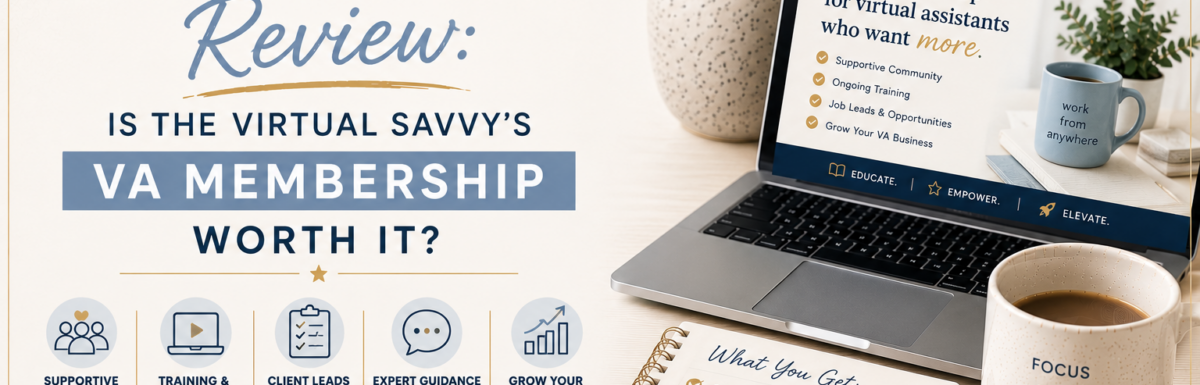
SavvySociety is a monthly or annual membership for virtual assistants and freelancers who already have at least one paying client and want structured coaching, skills training, and a clear roadmap to raise their rates and scale. It runs $97 a month or $947 a year. It’s a strong fit if you want ongoing coaching and community support. It’s not the right starting point if you haven’t landed a client yet, that’s a different program entirely (more on that below).
What Is SavvySociety?
SavvySociety used to be called SavvyVault. The Virtual Savvy rebuilt it into what they’re calling a “growth membership,” which basically means they added a structured roadmap on top of the training library that was already there.
The roadmap is split into two tracks:
GROW phases (for VAs still building momentum):
- Client Momentum
- Raise & Refine
- Specialize
- Offer Expansion
SCALE phases (for VAs ready to build a bigger operation):
- Systemize
- Delegate
- Predictable Leads
- CEO Transition
Each phase comes with a badge when you hit a milestone, like landing four recurring clients or successfully delegating to your first subcontractor. It’s a little gamified, but the underlying idea is solid: instead of guessing what to work on next, you follow the phase that matches where your business actually is.
What’s Included
Your membership fee covers everything below; there’s no upsell to individual courses.
Training library (60+ courses): Covers specific platforms and skills VAs commonly need, things like QuickBooks Online, Dubsado, Honeybook, Kajabi, Notion, ClickUp, social media management, SOP creation, and more. There’s also an “Executive VA” track and courses on niching into specific service areas.
Weekly group coaching calls: Live calls with The Virtual Savvy team where members can ask questions and get real-time feedback on their business.
Unlimited tech support: A dedicated tech team you can go to when you’re stuck on a platform, rather than burning hours on YouTube tutorials.
Community access: A private community of other VAs at similar stages, plus regular “Ask Abbey” sessions.
Job opportunities: Exclusive job leads shared only with members, several testimonials on the sales page mention landing their first or a long-term client through these.
Monthly Growth Drops: New resources and mini-trainings added each month, covering things like mindset, niche-specific strategy, or new AI tools for VAs.
What It Costs
- Monthly: $97/month, cancel anytime
- Yearly: $947/year (works out to just under $79/month, about two months free compared to paying monthly)
The yearly plan comes with a 7-day money-back guarantee. The monthly plan does not offer refunds, but you can cancel whenever you want and you’ll keep access through the end of your current billing period.
Pricing can change, so double-check the current rate on The Virtual Savvy’s site before you commit.
Who SavvySociety Is Best For
- VAs who already have at least one paying client and want to raise their rates with more confidence
- VAs who feel scattered trying to learn new platforms on their own and want a library they can return to whenever a client asks for something unfamiliar
- VAs who want structured coaching and accountability rather than figuring it out solo
- VAs thinking about eventually delegating or building a small team, since the SCALE phases cover hiring and systemizing
Why This Can Be a Good Fit for Mental Health VAs Specifically
Here’s the thing to understand up front: SavvySociety won’t teach you mental health billing, and it won’t teach you how to build out client charts or run notes inside an EMR like SimplePractice or TherapyNotes. That’s specialized knowledge that comes from billing-specific training (something like Bill Like a Boss or A Step Above’s courses), not from a general VA membership.
But billing and EMR data entry are only part of what a solo practice owner needs help with. A lot of the SavvySociety course library maps directly onto the non-clinical, non-billing work that eats up a therapist’s time, and that’s exactly where a VA can step in and become genuinely useful. Here’s how a few of the courses inside the membership translate into real services you could offer a practice owner:
SOP Creation → Documenting the practice’s back-office workflows. Most solo therapists have never written down how they handle intake, cancellations, or client offboarding, it all lives in their head. The SOP Creation course teaches you how to build clear, repeatable documentation. For a practice owner, that means you can come in and turn their tangled mental checklist into an actual system, which makes it much easier for them to eventually bring on a second clinician or admin support without everything falling apart.
Social Media Management & Content Management → Keeping the practice visible without adding to the therapist’s plate. Most therapists know they should be posting content to attract clients, but between sessions and notes, it’s usually the first thing to slip. These courses teach scheduling, content planning, and platform-specific strategy, skills you can apply directly to managing a practice’s Instagram or Facebook presence, batching content, and keeping a consistent posting schedule going.
QuickBooks Online, QuickBooks Self-Employed, and WaveApps → Light bookkeeping support. A lot of solo practice owners are also small business owners who never trained in bookkeeping. You won’t be doing anything billing-related here, this is general business bookkeeping, categorizing expenses, reconciling accounts, tracking practice income and overhead. It’s a genuinely useful add-on service, especially for therapists who are still doing their own books in a spreadsheet (or worse, a shoebox of receipts).
Asana, ClickUp, Monday.com, Trello, Notion → Systemizing how the practice runs day to day. Solo practice owners often juggle client scheduling, marketing tasks, admin to-dos, and continuing education deadlines with no central system. These project management courses teach you how to set up boards and workflows that a practice owner can actually stick with, something you could build once and then maintain for them.
Calendly → Managing scheduling and intake logistics. Not clinical scheduling inside the EHR, but the surrounding logistics: discovery calls for new clients, consult bookings, or coordinating a therapist’s non-session commitments like supervision or trainings.
Canva & Branding & Design → Building marketing materials. Rack cards, referral sheets, social graphics, intake packet covers, these courses give you the design skills to produce polished materials for a practice without needing to hire a separate designer.
Email Management & Email Marketing → Running the practice’s inbox and newsletter. This is general email skills, not HIPAA-compliant clinical communication, so you wouldn’t use this training to manage anything containing PHI. But plenty of practices also run a non-clinical email list for things like workshop announcements, group openings, or a practice newsletter, and that’s a task a VA can fully own.
AI 101 → Helping a practice use AI tools sensibly. This is general AI training, not health-specific, so it won’t cover HIPAA-safe AI use on its own. Pair it with your own knowledge of what’s safe to run through AI tools in a healthcare context (never client names, notes, or anything identifiable) and you can help a practice owner use AI for things like drafting marketing copy or brainstorming content ideas.
The pattern here is worth naming directly: SavvySociety is strongest for building out the operations and marketing side of a mental health VA’s service menu, the stuff that supports the practice around the edges of clinical work. It’s not a substitute for billing training, and it’s not going to teach you anything HIPAA-specific, you’ll still need to bring that knowledge from elsewhere (or from working with practices directly) before you touch anything involving client data. But if you’re a VA trying to expand past “I do the receptionist stuff” into “I run your operations, marketing, and books,” this library gives you a real path to build those skills out one at a time.
Who It’s Not Best For
- Brand new VAs with no clients yet. The Virtual Savvy is upfront about this one themselves, their sales page recommends starting with their SavvySystem Accelerator instead if you haven’t landed a paying client. SavvySociety assumes you’re already working with someone.
- VAs who only want one specific course. You can’t buy individual trainings separately. If you only need, say, the Dubsado course, you’d be paying for a full membership to get it (though nothing stops you from grabbing what you need and canceling afterward if the monthly plan fits that approach).
- Anyone who prefers self-paced learning with no community or coaching component. A chunk of the value here is the live calls and group support. If you’d rather quietly work through material on your own time, a smaller standalone course might suit you better.
- VAs specifically looking for mental health billing training. SavvySociety is a general VA business growth membership; it’s not built around mental health billing specifically. If insurance billing is your main service, pair this with something like Bill Like a Boss for the billing-specific piece.
A Few Things Worth Knowing Before You Join
- There’s no lower-tier or trial option beyond the yearly refund window, so you’re committing to a month or a year upfront.
- Because it’s a membership and not a one-time course, the value really depends on whether you use it. If you join and never show up to a coaching call or touch the training library, $97 a month adds up fast for something sitting unused.
FAQ
Do I need experience to join SavvySociety?
You need at least one paying client already. If you’re starting from zero, The Virtual Savvy points people toward their SavvySystem Accelerator program first.
Is SavvySociety specific to mental health VAs?
No, it’s built for VAs and freelancers broadly. If your clients happen to be therapists or mental health practices, the skills still transfer, but you won’t find mental health billing codes or insurance-specific training inside.
Can I cancel anytime?
Yes, on the monthly plan. You keep access through the rest of your current billing period after canceling.
Is there a refund if I don’t like it?
The yearly plan has a 7-day money-back guarantee. The monthly plan doesn’t offer refunds, but there’s no long-term contract either.
How is SavvySociety different from SavvyVault?
SavvyVault was mostly a training library. SavvySociety kept that library but added the phase-based roadmap and leaned harder into live coaching and community, so it’s positioned more as ongoing business growth support than just a course catalog.
Bottom Line
SavvySociety is a great “next step” program, not a starting point. If you’re already working with clients and want a clearer path to raising your rates, picking up new skills as they come up, and having a community to lean on, it’s a reasonable investment at $97 a month. Check it out here.
If you’re earlier in the journey and want to compare training options across the board, check out my roundup of medical billing courses for therapists and billers to see where SavvySociety fits alongside other options.
